


45VM62-000-4 Pacific Scientific
Wake Industrial LLC is not an authorized distributor of this product.
Wake Industrial LLC is not an authorized distributor of this product.
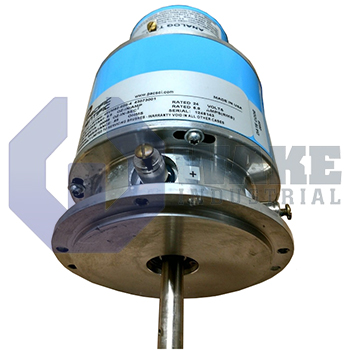
The Pacific Scientific 45VM62-000-4 is part of the Low Inertia PMDC Servomotors series and has a rated voltage of 36 volts with a rated current of 10.4 amps. It offers a rated torque of 1.666 Newton-meters, a power dissipation of 130 watts, and features no forced-air cooling or attached analog tachometer.
Internal Product Review
The 45VM62-000-4 is a Pacific Scientific low inertia PMDC servomotor built for responsive motion control, with a 36 V rating and 10.4 A rated current. Rated torque of 1.666 N·m and 1.00 °C/W thermal resistance support stable, efficient servo performance.
 Have a part to sell?
 Wake Industrial Warranty
To contact sales for pricing and lead time:
Payment Methods


Shipping Methods


Our Credentials


Product Description:
The 45VM62-000-4 is a permanent-magnet DC motor built by Pacific Scientific within the Low Inertia PMDC Servomotors series. Its lightweight rotor and short electrical time constant support quick response on indexing tables, pick-and-place heads, and other positioning axes that need tight current-to-torque control. In an automation cell, the unit converts armature current directly into mechanical torque, allowing the external drive to regulate speed and position without the delay common to higher-inertia machines. The low-inertia design also helps the motor respond quickly to command changes during short cycling moves. That behavior is useful where repeated starts, stops, and reversals occur within short move profiles.
Nominal operation is specified at 36 V. At that voltage, the armature draws 10.4 A of continuous current and produces a stabilized shaft output of 1.666 N·m. Copper and iron losses total 130 W, which must be removed through the frame during steady operation. With a thermal path of 1.00 °C/W, winding temperature rise can be estimated from total loss and ambient conditions. Because the chassis uses no forced-air cooling, the motor is typically bolted to a conductive machine plate so natural convection and conduction can carry away heat.
Feedback hardware is intentionally omitted: the tachometer flange has no attached feedback device, and the opposite shaft end has no optical encoder. Users can therefore add a resolver, an incremental disk, or a Hall-effect device that matches the control method and required signal type. This arrangement leaves signal selection tied to the application instead of a fixed factory-installed option. Separate feedback mounting lets the same motor platform work with different controller types and axis layouts. The absence of built-in feedback keeps the motor adaptable for systems that already use a preferred sensing package.









