


3N63-100-2 Pacific Scientific
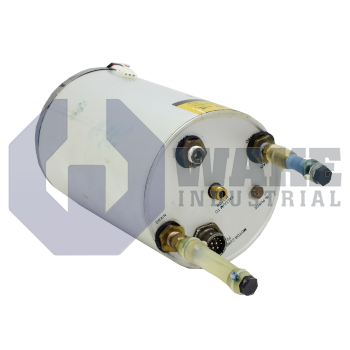
Wake Industrial LLC is not an authorized distributor of this product.
Wake Industrial LLC is not an authorized distributor of this product.
The Pacific Scientific 3N63-100-2 is part of the Low Inertia PMDC Servomotors series and delivers a rated torque of 0.61 Newton-meters at a rated speed of 3730 RPM. It operates at a rated current of 12.2 Amps and a rated voltage of 42 Volts, with a power output of 237 Watts. The servomotor has a back emf constant of 5.85 V per kRPM and a rotor inertia of 3.3 x 10^-6 kg·m².
Internal Product Review
The 3N63-100-2 is a Pacific Scientific low inertia PMDC servomotor with 3.3 × 10^-6 kg·m² rotor inertia and a 1.4 ms mechanical time constant. Rated operation at 3730 RPM and 237 W gives the motor a very responsive, efficient character in dynamic servo applications. A 0.650 N·m continuous stall torque stands out as a strong advantage for compact motion systems.
 Have a part to sell?
 Wake Industrial Warranty
To contact sales for pricing and lead time:
Payment Methods


Shipping Methods


Our Credentials


Product Description:
Pacific Scientific manufactures the 3N63-100-2, a permanent-magnet DC servo motor in the Low Inertia PMDC Servomotors series. The unit is intended for closed-loop motion axes where quick acceleration and precise velocity control are required, such as pick-and-place heads and light conveying modules. Its role in industrial automation is to convert commanded armature current into regulated rotary torque while keeping mechanical lag to a minimum. The motor layout supports fast response during start, stop, and reversal, which is useful on axes that must change speed frequently.
The motor operates from a nominal bus of 42 V and, at a rated armature draw of 12.2 A, produces 0.61 N·m at 3730 rpm for continuous duty. A back-electromotive-force constant of 5.85 V/kRPM indicates the voltage returned to the drive as speed rises, while the torque constant of 0.056 N·m/A gives a direct current-to-torque ratio for simple loop tuning. Terminal resistance is 1.29 Ω and rotor inductance is 210 µH, and these values affect current rise, ripple, and commutation behavior. The motor delivers 237 W of mechanical power and rejects 275 W of heat through its frame, while temperature rise is limited by a thermal resistance of 0.47 °C/W. A 1.4 ms mechanical time constant, supported by the 3.3 × 10⁻⁶ kg·m² rotor inertia, indicates how rapidly speed changes in response to voltage commands.
When held stationary, the shaft can sustain 0.650 N·m continuously without exceeding winding limits. For fast indexing moves, the drive may supply up to 36 A of pulse current, enabling short acceleration bursts until rotation approaches the no-load cap of 7000 rpm. The published thermal path allows these transient events to repeat frequently, provided external cooling matches the dissipation rate. This operating pattern suits servo axes that spend much of the cycle accelerating, decelerating, and settling between short moves.