


3N63-000-3 Pacific Scientific
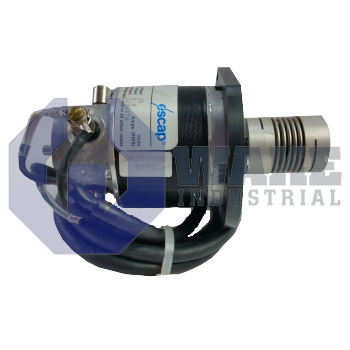
Wake Industrial LLC is not an authorized distributor of this product.
- Straightforward Pricing: No Rush Fees, No Credit Card Fees
The Pacific Scientific 3N63-000-3 is part of the Low Inertia PMDC Servomotors series and offers a rated power output of 88 W with a rated current of 3.5 A. This servomotor provides a rated torque of 31 oz-in and a rated speed of 3830 RPM. It features a back EMF constant of 8.36 V per kRPM and does not use any external cooling method.


To contact sales for pricing and lead time:
Payment Methods


Shipping Methods


Our Credentials


Product Description:
The 3N63-000-3 is a permanent-magnet DC servomotor produced by Pacific Scientific for the Low Inertia PMDC Servomotors series. It provides precision rotary actuation for industrial automation tasks that need quick acceleration and repeatable position control without adding complex cooling hardware. The low-inertia rotor allows the motor to follow rapid command changes, making it suitable for small pick-and-place axes, labeling heads, or light-load web transport stages.
This model is designed around a nominal supply of 42 V, and its armature resistance of 2.75 Ω affects steady-state current draw at that voltage. Under continuous rated load, the winding carries 3.5 A rms, producing a back electromotive force of 8.36 V/kRPM that the drive must overcome to maintain motion. At the operating point of 3830 rpm, electromagnetic conversion yields a shaft load of 31 oz-in (0.22 Nm). The short electrical time constant of 0.15 ms allows current to rise quickly when a step command is applied, while the mechanical time constant of 1.6 ms shows how quickly the rotor reaches a new velocity. A 400 µH rotor inductance helps moderate commutation ripple and supports noise filtering in the controller.
For brief overloads, the winding can accept a 26 A pulse, and the magnetic circuit will withstand a continuous stall load of 33 oz-in (0.233 Nm) without demagnetization. The torque constant is 11.3 oz-in/A, which links commanded current to output torque, and the 0.00052 oz-in-s² rotor inertia helps keep servo lag low during speed reversals. A maximum no-load velocity of 4850 rpm and a rated mechanical output of 88 W complete the speed-to-power range. With no forced airflow or liquid jacket, the lack of forced cooling means heat is conducted through the mounting face, so the installation surface must provide a suitable thermal path.









