


33VM82-020-19 Pacific Scientific
Wake Industrial LLC is not an authorized distributor of this product.
- Straightforward Pricing: No Rush Fees, No Credit Card Fees
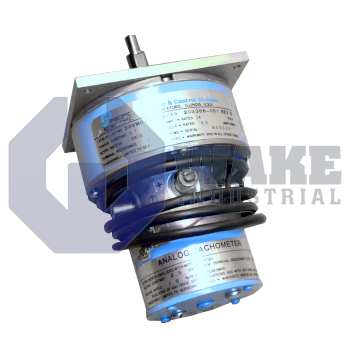
The Pacific Scientific 33VM82-020-19 is a servo motor from the Low Inertia PMDC Servomotors series. It uses PMDC motor technology, operates at a rated voltage of 24 VDC, and draws a rated current of 6 Amps. This motor features an analog tachometer as its feedback device and has a terminal resistance of 0.85 Ohm.


To contact sales for pricing and lead time:
Payment Methods


Shipping Methods


Our Credentials


Product Description:
The 33VM82-020-19 is a permanent-magnet DC servo motor produced by Pacific Scientific for the Low Inertia PMDC Servomotors series. It is intended for indexing tables, feeders, and pick-and-place heads that require fast response and stable speed control. A lightweight armature paired with a permanent-magnet stator keeps stored rotational energy low, so the motor can reverse quickly with limited overshoot. That low rotating mass is useful on axes that start and stop often, where short moves and repeatable speed changes are part of normal operation. The motor is well suited for compact closed-loop motion systems that rely on low-voltage power and consistent response.
The motor draws a continuous current of 6 A, which helps set conductor sizing and thermal loading during sustained operation. It runs from a nominal 24 VDC supply, allowing direct use with common low-voltage power sources found in distributed control panels. The windings have a terminal resistance of 0.85 ohm, which affects starting current and current-loop behavior in the paired amplifier. Speed feedback is provided by an analog tachometer, so classic velocity loops can regulate motor speed with a proportional feedback signal. This combination of low-voltage supply, moderate current demand, and analog feedback fits traditional servo systems that emphasize straightforward speed control.
This motor uses DC input and brush commutation, so current is switched at the armature without separate external commutation electronics. The PMDC layout eliminates separate field excitation and keeps the package compact for machines where panel space is limited. Low rotor inertia reduces control effort during acceleration and deceleration, which helps shorten response time in repetitive indexing and pick-and-place motion. Magnetic stability and the low-mass rotating assembly support steady torque rise during load changes while maintaining accurate analog speed feedback. It is commonly applied where rapid reversals, stable velocity control, and a compact motor are needed within a 24 V power architecture.









