


33VM62-220-19 Pacific Scientific
Wake Industrial LLC is not an authorized distributor of this product.
Wake Industrial LLC is not an authorized distributor of this product.
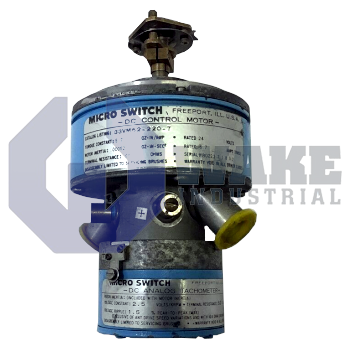
The Pacific Scientific 33VM62-220-19 servomotor is part of the Low Inertia PMDC Servomotors series and uses carbon brushes with a shaft-mounted commutator. This motor features Alnico V-7 magnet material and is cooled with an air inlet and outlet with baffles. It has a hollow, basket wound rotor and includes standard provisions for encoder mounting.
Internal Product Review
The 33VM62-220-19 is a Pacific Scientific low inertia PMDC servomotor featuring a hollow rotor and basket wound rotor winding for responsive motion performance. Field-replaceable brushes and a standard tachometer support efficient serviceability and dependable feedback in demanding drive systems. Air inlet and outlet baffles further improve cooling, making the servomotor a strong choice for precision motor applications.
 Have a part to sell?
 Wake Industrial Warranty
To contact sales for pricing and lead time:
Payment Methods


Shipping Methods


Our Credentials


Product Description:
The 33VM62-220-19 is produced by Pacific Scientific within the Low Inertia PMDC Servomotors series. This motor is applied in automation loops that demand rapid response to command signals, where its low-inertia rotor permits fast velocity changes without overshoot. By coupling directly to a servo drive, the unit supplies regulated torque for positioning tables, small conveyors, or light rotary actuators in assembly machinery, where repeated starts, stops, and short indexing moves are common.
The power section is commutated through carbon brushes that ride on a shaft-mounted commutator; wear items can be replaced because brush serviceability is rated as field-replaceable. Core cooling relies on forced air that follows a dedicated air inlet and outlet with baffles, directing flow across the armature to stabilize winding temperature during continuous duty. Magnetic flux is generated by permanent bars of Alnico V-7, a material chosen for thermal stability and resistance to demagnetization. No rotating iron is present in the magnetic circuit, so eddy-current losses are minimized and acceleration torque is improved, and a standard encoder mounting provision is machined into the tail-shaft housing for later feedback upgrades when higher resolution is needed.
Speed feedback in the base configuration is supplied by a standard tachometer, which produces an analog voltage proportional to shaft speed and allows a drive to close the velocity loop without an external sensor. The rotor uses a hollow rotor design, and its conductors are arranged in a basket-wound pattern, which keeps inertia low while maximizing available copper in the active area. The motor is supplied with no optical encoder attached at the factory, so users can select incremental or absolute devices that match their control architecture. Because there is no rotating iron, the motor exhibits smooth torque with negligible cogging across its usable speed range and maintains consistent response during repeated acceleration and deceleration.









