


33VM52-000-20 Pacific Scientific
Wake Industrial LLC is not an authorized distributor of this product.
Wake Industrial LLC is not an authorized distributor of this product.
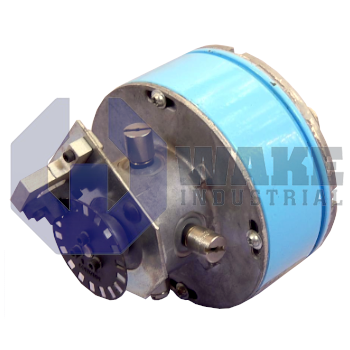
The Pacific Scientific 33VM52-000-20 is a PMDC servomotor from the Low Inertia PMDC Servomotors series featuring a 24 V input voltage and a rated current of 6.2 Amps. It uses a hollow rotor design with Alnico V-7 magnet material and is equipped with carbon brushes. The primary shaft diameter is 5/16 inch and the motor is not fitted with forced-air cooling.
Internal Product Review
The 33VM52-000-20 is a PMDC servomotor featuring a hollow rotor for quick acceleration and smooth response in servo duty. A 24 V input and 6.2 A rated current support straightforward integration into common DC motion platforms. Carbon brushes and a no forced-air cooling design keep the package practical and efficient for low-inertia applications.
 Have a part to sell?
 Wake Industrial Warranty
To contact sales for pricing and lead time:
Payment Methods


Shipping Methods


Our Credentials


Product Description:
The 33VM52-000-20 is a permanent-magnet DC servomotor produced by Pacific Scientific for the Low Inertia PMDC Servomotors series. Within industrial automation, it supplies controllable torque and rapid response for indexing tables, small actuators, and pick-and-place devices. By combining a lightweight rotor with surface-mounted field magnets, the motor minimizes rotational inertia so a drive can change speed or reverse direction with minimal delay while maintaining tight velocity and position loops in compact machine axes. This behavior is useful on compact axes that must start, stop, and reverse frequently during repetitive machine cycles in automated equipment.
This model operates from a supply of 24 V and draws a continuous armature current of 6.2 A. Those values describe the steady electrical load that the paired servo amplifier must supply. Motion reliability is supported by carbon brushes that slide on the commutator and tolerate frequent cycling without excessive wear. Field flux derives from Alnico V-7 magnets, giving stable magnetic density over a wide temperature range and eliminating the need for field excitation windings. A hollow rotor keeps mass low, shortening acceleration times, and the design uses no forced-air cooling so copper losses are dissipated through frame conduction. This arrangement suits enclosures with limited airflow and servo loops that benefit from quick dynamic response.
Mechanical output is available on two shafts. The primary end has a diameter of 5/16 in for coupling to pinions or timing pulleys, and the opposite end provides a 1/4 in secondary stub that can carry minimal-load accessories such as tachometer wheels. Feedback hardware is intentionally omitted, with no attached encoder provided for the optical encoder interface, so position or speed sensing must be handled by external devices if required.









