


2VM62-000-6 Pacific Scientific
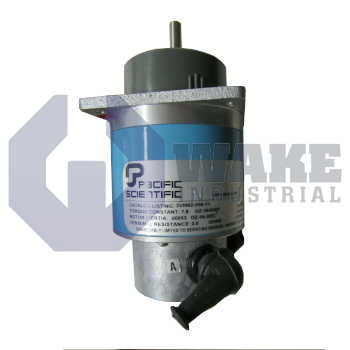
Wake Industrial LLC is not an authorized distributor of this product.
Wake Industrial LLC is not an authorized distributor of this product.
The Pacific Scientific 2VM62-000-6 is part of the Low Inertia PMDC Servomotors series and uses Alnico V-7 magnet material. This servomotor features carbon brushes with a brush life of 5000 hours and has no forced-air cooling provision. Its peak torque capability is five times the rated torque.
Internal Product Review
The 2VM62-000-6 is a Pacific Scientific PMDC servomotor using Alnico V-7 magnet material. Carbon brushes rated for 5000 h support dependable service, and the no forced-air cooling arrangement simplifies integration. Peak torque capability of 5x rated torque makes the motor an excellent choice for dynamic servo applications.
 Have a part to sell?
 Wake Industrial Warranty
To contact sales for pricing and lead time:
Payment Methods


Shipping Methods


Our Credentials


Product Description:
The 2VM62-000-6 is a direct-current servo motor produced by Pacific Scientific and belongs to the Low Inertia PMDC Servomotors series. As a permanent-magnet unit, it converts armature current into rapid torque changes, making it suitable for position loops and light linear stages in industrial automation. Its low-inertia profile enables short acceleration times, which supports indexing tables, pick-and-place axes, and other motion tasks that need fast directional reversals. This response also helps the motor follow changing command signals without adding unnecessary rotating mass.
The motor is classified as a PMDC servomotor, so field excitation is provided by permanent magnets rather than a wound stator, reducing electrical losses and simplifying drive circuitry. Peak torque can rise to 5× rated torque, giving added headroom during starts, reversals, or sudden load disturbances. Current is commutated through carbon brushes, a contact material selected for low resistivity and stable film formation, and the brushes have an expected service life of 5000 h under normal operating conditions. Magnetic flux is supplied by an Alnico V-7 magnet assembly, which resists demagnetization during high current transients and supports the motor’s low-inertia behavior.
There is no forced-air provision, so heat is removed by natural convection and the thermal mass of the mounting structure. For velocity feedback, the motor is supplied with no analog tachometer and no optical encoder, so it can be paired with external feedback devices or used in open-loop torque mode when tight speed regulation is not required. Omitting built-in feedback hardware reduces package length and wiring complexity. Closed-loop speed or position control therefore requires a separate sensing device that matches the needs of the axis.









