


2VM62-000-3 Pacific Scientific
Wake Industrial LLC is not an authorized distributor of this product.
Wake Industrial LLC is not an authorized distributor of this product.
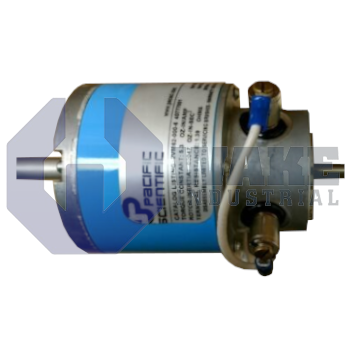
The 2VM62-000-3 is a low inertia PMDC servomotor manufactured by Pacific Scientific and is part of the Low Inertia PMDC Servomotors series. This motor features a rated speed of 3700 RPM and delivers a rated torque of 0.155 Nm at a rated voltage of 36 volts. It uses Alnico V-7 magnet material, offers a continuous power dissipation of 54 watts, and supports a maximum pulse current of 16 amps.
Internal Product Review
The 2VM62-000-3 is a Pacific Scientific low inertia PMDC servomotor that stands out in dynamic motion applications, pairing 3.6 x 10^-6 kg-m^2 rotor inertia with a 3700 RPM rated speed. Rated for 36 V operation and 0.155 Nm torque, the motor delivers smooth, efficient performance for precise servo duty.
 Have a part to sell?
 Wake Industrial Warranty
To contact sales for pricing and lead time:
Payment Methods


Shipping Methods


Our Credentials


Product Description:
The 2VM62-000-3 permanent-magnet DC servomotor is produced by Pacific Scientific within the Low Inertia PMDC Servomotors series. It provides bidirectional shaft motion for compact industrial axes where quick reversals and precise velocity control are required. By combining a low-mass armature with a constant-flux Alnico field, the motor supports tight position loops when driven from a basic servo amplifier. It is typically mounted on small conveyors, labeling machines, or laboratory fixtures where rapid dynamic response is more important than high torque output.
Under nominal operating conditions, the motor is supplied with an armature voltage of 36 V and draws 3.2 A of root-mean-square current. At this operating point, the shaft delivers a rated speed of 3700 rpm and a steady output torque of 0.155 Nm, which corresponds to 60 W of mechanical power. Because the internal armature produces a back electromotive force of 5.76 V/kRPM, the drive controller must provide enough voltage to overcome this generated voltage plus brush drops. The motor has a torque constant of 0.055 Nm/A, so incremental current changes translate linearly into proportional torque changes during closed-loop control.
For startup transients or short overloads, the amplifier can supply a pulse current of up to 16 A, letting the motor exceed its continuous capability without thermal damage while remaining within the 54 W dissipation limit of the winding. The armature can withstand stall loading with a continuous torque of 0.162 Nm when adequate heat sinking is provided, and no forced-air cooling is required. Dynamic behavior is aided by the low rotor inertia of 3.6 × 10⁻⁶ kg·m², so acceleration toward the no-load speed of 6010 rpm occurs quickly even in systems without an attached analog tachometer or optical encoder.









