


2VM62-000-1 Pacific Scientific
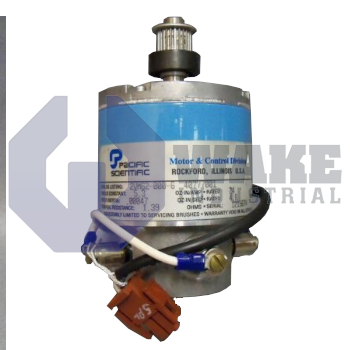
Wake Industrial LLC is not an authorized distributor of this product.
Wake Industrial LLC is not an authorized distributor of this product.
The Pacific Scientific 2VM62-000-1 is part of the Low Inertia PMDC Servomotors series and provides a rated output power of 163 Watts with a rated speed of 1450 RPM. This servomotor features a continuous stall torque of 1.33 Newton-meters and rated torque of 1.04 Newton-meters at a rated voltage of 20 Volts. It also offers a rotor inertia of 5.1 x 10^-5 kilogram-meter squared and a motor inductance of 100 milliHenries.
Internal Product Review
The 2VM62-000-1 is a Pacific Scientific low inertia PMDC servomotor built for responsive motion control. Rated output of 163 W and rated speed of 1450 RPM support efficient performance in dynamic servo applications. Continuous stall torque of 1.33 N·m pairs well with low rotor inertia of 5.1 x 10^-5 kg·m², making the unit a strong choice for quick, precise positioning.
 Have a part to sell?
 Wake Industrial Warranty
To contact sales for pricing and lead time:
Payment Methods


Shipping Methods


Our Credentials


Product Description:
The 2VM62-000-1 direct-current servomotor is produced by Pacific Scientific and belongs to the Low Inertia PMDC Servomotors series. As a permanent-magnet unit with minimized rotor mass, it is intended for tightly controlled positioning or velocity loops in pick-and-place heads, labeling tables, and other light industrial axes. Its low-inertia design helps the motor respond quickly to command changes, which supports short indexing moves and frequent start-stop operation.
Its nominal electrical input is 20 V. This low voltage lets the motor be driven directly from compact servo amplifiers while limiting arc-over risks in mobile equipment. At that supply, the shaft reaches 1450 RPM, providing a mid-range mechanical speed suitable for gearless coupling to lead screws. The corresponding shaft output is 1.04 N·m of rated torque, so the motor can maintain this load continuously without exceeding thermal limits. When speed and torque are considered together, the device yields 163 W of rated power, giving a clear indication of its continuous mechanical output. Armature inductance is 100 mH, which affects the electrical time constant and the rate at which current can be modulated by the drive.
For load cases that momentarily resist rotation, the electromagnetic system can hold 1.33 N·m at stall without overheating, allowing closed-loop control to apply static force for clamping or tension tasks. Dynamic response is influenced by the rotor inertia of 5.1 × 10⁻⁵ kg·m², and this low value supports rapid velocity reversals with modest drive current demand. Startup friction is limited to 0.07 N·m, reducing the deadband that the controller must overcome during fine incremental moves. Viscous damping of 0.07 N·m/kRPM helps smooth velocity ripple under light loads. These operating characteristics make the motor suitable for applications that require stable low-speed behavior as well as repeatable transient response.