


2VM52-020-6 Pacific Scientific
Wake Industrial LLC is not an authorized distributor of this product.
- Straightforward Pricing: No Rush Fees, No Credit Card Fees
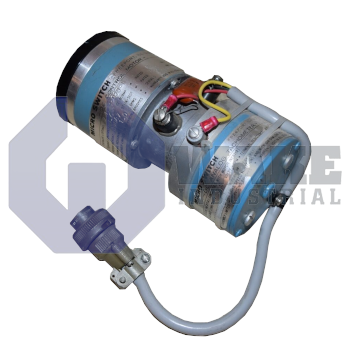
The 2VM52-020-6 is a servo motor from the Low Inertia PMDC Servomotors series by Pacific Scientific. It features a standard analog tachometer with a voltage constant of 2.5 V per kRPM and uses Alnico V-7 as the magnet material. The motor does not have forced-air cooling and comes without an attached optical encoder.


To contact sales for pricing and lead time:
Payment Methods


Shipping Methods


Our Credentials


Product Description:
The 2VM52-020-6 is a low-inertia permanent-magnet DC servomotor produced by Pacific Scientific as part of the Low Inertia PMDC Servomotors series. The motor supplies rapid torque changes that suit indexing tables, pick-and-place axes, and other automation stages that demand tight velocity control. Instead of a digital sensor, the frame carries a standard analog tachometer that produces a proportional voltage for the drive, enabling closed-loop speed regulation without additional feedback hardware. As a brush-type design, it blends moderate armature current with low rotor inertia to shorten settling time in light-duty automation cells.
The tachometer drum has an outside diameter of 2.765 in, while its housing length is 2.062 in; these dimensions set the space required at the non-drive end of the motor. Dynamic behavior is aided by a rotor inertia of only 0.00005 oz-in-s², so acceleration of the sensing element barely loads the armature. Electrical loading on the speed circuit is governed by a coil resistance of 50 Ω, and the generator produces 2.5 V/kRPM under nominal conditions, giving the drive a predictable voltage range for analog speed loops.
Pacific Scientific lists additional performance markers for tachometer signal quality. Deviation from ideal slope is held within ±0.5%, and residual ripple does not exceed 1.5% p-p, reducing velocity error when the drive performs fine regulation. Motor flux is established with Alnico V-7 magnets, offering stable field strength across a wide temperature span without requiring rare-earth materials. Because there is no forced-air provision, the housing relies on natural convection, so unobstructed airflow around the frame supports continuous-duty operation. An optical encoder is not attached, so applications that need position data must provide an external device.









