


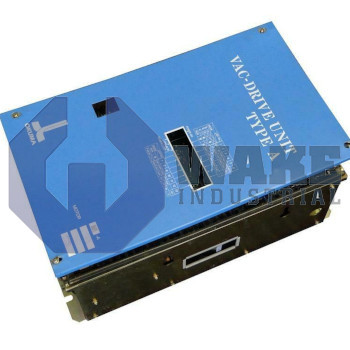
VAC1-D8-B Okuma
Wake Industrial LLC is not an authorized distributor of this product.
Wake Industrial LLC is not an authorized distributor of this product.
MPN: VACA303J
The Okuma VAC1-D8-B is part of the VAC Spindle Drives series and features an analog interface type with isolated control ground. It includes a VAC Board II and VAC Card 1 control PCB set, and supports analog voltage speed command input. Motor signal connectors include 16-pin, 10-pin, and 9-pin options, while monitor outputs are VEL ±10 V and TQ ±10 V.
Internal Product Review
The VAC1-D8-B is an Okuma VAC spindle drive with an analog interface and 16-bit processing. Isolated control ground and analog voltage speed command support clean integration with established machine control architectures. VEL ±10 V and TQ ±10 V monitor outputs make diagnostics straightforward, a standout feature for precise spindle tuning.
 Have a part to sell?
 Wake Industrial Warranty
To contact sales for pricing and lead time:
Payment Methods


Shipping Methods


Our Credentials


Product Description:
The VAC1-D8-B is a spindle drive module produced by Okuma within the VAC Spindle Drives series. It serves as the power and control interface between a CNC controller and a high-speed spindle motor, converting command signals into regulated torque and velocity for metal-cutting processes and other automated machining tasks. In normal operation, the module manages spindle response during acceleration, constant-speed cutting, and deceleration so the motor follows the command profile sent by the machine control.
The control section is galvanically separated because its ground path is isolated, helping suppress noise between logic and power domains. Drive intelligence resides on a dual-board stack made up of VAC Board II + VAC Card 1, which combines motion processing with input and output conditioning on one assembly. All host interaction is through an analog interface, so velocity or torque references are accepted as proportional voltages rather than digital words. Internal arithmetic operates on a 16-bit data path, giving adequate numerical resolution for loop calculations and position estimation. Feedback from the spindle’s resolver is captured every 128 µs, which sets the update period for speed estimation and supports stable low-speed control.
Status can be monitored through buffered outputs labeled VEL ±10 V; TQ ±10 V, which mirror real-time velocity and torque commands for oscilloscope diagnostics. Motor feedback, resolver lines, and encoder power are routed through housings rated at 16-pin, 10-pin, and 9-pin, which helps organize the external connections. Cabinet installation uses a slotted frame with an upper slot x2 and lower round slot x2 mounting pattern so the unit can slide into the rack and be secured without extra brackets. Speed references arrive as an analog voltage that changes linearly with commanded RPM. Power lugs are matched to the application wiring; the cooling fan lands on M4 screws, while both motor and DC supply leads terminate on the larger fittings described as fan M4, motor M5, and supply M5.