


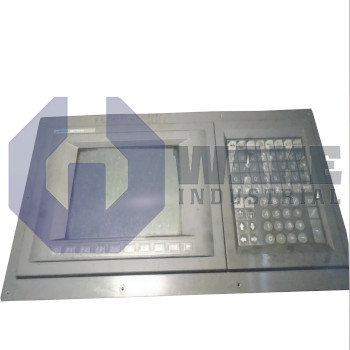
OSP-7000L Okuma
Wake Industrial LLC is not an authorized distributor of this product.
Wake Industrial LLC is not an authorized distributor of this product.
The OSP-7000L is a CNC monitor by Okuma and is part of the OSP CNC Monitors series. It features a 12-inch color CRT display, supports up to 2 control axes (X, Z), and utilizes an absolute position encoder. The monitor provides linear and circular interpolation, offers a program memory of 24,000 characters, and includes a serial RS232C interface.
Internal Product Review
The OSP-7000L is an Okuma OSP CNC monitor with 2-axis control and linear/circular interpolation for efficient lathe operation. A 12-inch color CRT and absolute position encoder support clear process visibility and dependable positional tracking. Program memory rated for 24000 characters makes the unit a capable and practical CNC monitoring platform.
 Have a part to sell?
 Wake Industrial Warranty
To contact sales for pricing and lead time:
Payment Methods


Shipping Methods


Our Credentials


Product Description:
The OSP-7000L is a CNC control monitor produced by Okuma within the OSP CNC Monitors series. It acts as the operator interface and numerical-control processor on turning and milling platforms, supplying the visual, memory, and I/O resources required to execute part programs and track machine status in real time. This arrangement lets the monitor present status screens, accept operator input, and execute stored machining instructions without interrupting machine operation.
The unit supervises machining over 2 (X,Z) coordinated axes and displays status data on a 12-inch color CRT that supports a 64-character × 24-line text grid for clear code review. Programming is stored in a buffer that accepts up to 24000 characters, and it recognizes both the ISO (R840) and EIA (RS-244A) coding formats, allowing legacy tape programs to coexist with modern CAM output. Minimum commanded motion is 1 µm, enabling fine incremental positioning, while linear and circular interpolation let the control create continuous tool paths between points. Motion feedback is supplied by an absolute position encoder, so no home sequence is needed and reference zero return is not required. Operators can adjust feed in 15 discrete override steps, and position values may be entered directly from the panel or through a tape reader working at 270 char/s.
For offset management, each tool can be shifted by up to 99999.999 mm, and the database stores 32 tool-offset pairs to support multi-station turrets. This allows geometry and wear corrections to be organized separately from the main machining program. Spindle speed can be trimmed in 10 override steps, giving quick reaction to surface-speed changes. External communication is handled through an RS232C serial link, making it possible to drip-feed lengthy programs or archive setups. The control accepts incremental commands as large as ±99999.999 mm, which allows large programmed position changes when the application requires them.









