


E4809-436-047-C Okuma
Wake Industrial LLC is not an authorized distributor of this product.
- Straightforward Pricing: No Rush Fees, No Credit Card Fees
Current response time:
5 Minutes
5 Seconds
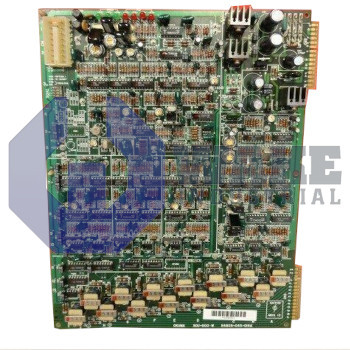
The Okuma E4809-436-047-C is a communication control board from the E4809 CNC Boards series. It supports a fiber optic network medium, functioning as a substation and converting signals between optical and electrical formats. The board can host up to one Foht card and four Fopt cards, interfacing with its host through an FN card.


To contact sales for pricing and lead time:
Payment Methods


Shipping Methods


Our Credentials


Product Description:
The E4809-436-047-C board is produced by Okuma within the E4809 CNC Boards series. It is a plug-in communication module used inside CNC racks to manage optical data exchange between the main control CPU and distributed motion or I/O stations. By converting and routing signals over machine-mounted fiber lines, the board supports coordinated traffic for axes, tool changers, and peripheral sensors during automated machining cycles. This arrangement helps the control system keep data paths isolated from electrical noise generated by spindle drives and servo hardware.
The board’s primary role is identified as optical communication control, meaning its circuitry times and encodes traffic that travels on light-based links. Connection to the CNC backplane is through an FN card interface that supplies both command words and operating power from the host rack. All channel traffic uses a fiber-optic medium, which helps maintain signal integrity in electrically noisy machine environments. Incoming messages pass through an optical-to-electrical receive conversion stage so logic-level signals can be processed by the controller. Outgoing frames pass through a complementary electrical-to-optical driver that restores light pulses for network transmission. These paired conversions allow the cabinet electronics to process standard internal signals while sending optical data across the machine.
System capacity is limited to 1 FOHT supervisory card and up to 4 FOPT distribution cards, allowing a modular hierarchy in which this module acts as a substation node under a higher-level master. Within that arrangement, the board passes timing, diagnostics, and handshake signals needed for deterministic motion sequencing. Its compatibility with other modules in the E4809 CNC Boards family keeps connector placement and mounting format aligned across related assemblies. That layout supports organized signal distribution between the control rack and remote machine functions.









