


E4809-045-122-E Okuma
Wake Industrial LLC is not an authorized distributor of this product.
MPN: 1911-1548-08-8
No Tariffs On US Orders- Straightforward Pricing: No Rush Fees, No Credit Card Fees
Current response time:
5 Minutes
53 Seconds
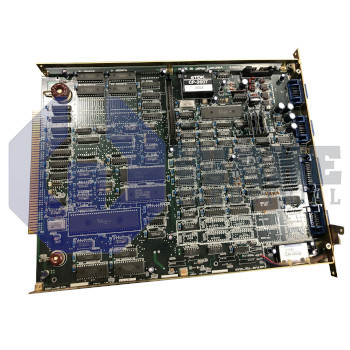
The Okuma E4809-045-122-E is an electrical control processor board from the E4809 CNC Boards series, featuring a 16-bit processor with a clock frequency of 15 MHz. It is equipped with 128 Kbyte DRAM main memory and 48 Kbyte SRAM for backup, and supports two F-Type encoder channels. This board also has an EC bus buffer, EC bus interface, and operates with a 3.6 V lithium backup battery.


To contact sales for pricing and lead time:
Payment Methods


Shipping Methods


Our Credentials


Product Description:
The E4809-045-122-E is an electrical control processor board produced by Okuma within the E4809 CNC Boards series. Installed inside CNC control cabinets, the board executes axis calculations, manages peripheral buses, and retains operating data for the machine tool. By consolidating motion processing and memory resources on a single module, it reduces wiring complexity and supports deterministic cycle times required in automated machining cells. Okuma assigns this part to its OSP platform, positioning it as the primary arithmetic layer between the master controller and the servo interfaces.
The board operates at a clock frequency of 15 MHz, a rate that matches the timing of the servo scheduler and permits predictable instruction throughput. A 16-bit processor width allows direct manipulation of word-length machine variables while minimizing bus contention. Volatile program space is supplied by 128 Kbyte DRAM, giving the processor room for the real-time kernel, interpolation tables, and buffering tasks. Additional storage is provided by 48 Kbyte SRAM, which holds position offsets and tool wear data for restart recovery. For direct feedback capture, the board provides 2 encoder channels, enabling simultaneous monitoring of two motion axes without an external multiplexer.
The retention system is completed by a 3.6 V lithium battery that maintains the SRAM map when mains power is absent. Communication with expansion modules uses an integrated EC bus buffer that conditions line signals and an EC bus interface that presents the handshake protocol to neighboring I/O cards. The feedback ports are matched to a F-type encoder, allowing differential signal reception and noise rejection suited to high-speed spindles. This arrangement keeps spindle and axis data synchronized with numerical commands during unattended operation.









