


E4809-045-122-C Okuma
Wake Industrial LLC is not an authorized distributor of this product.
MPN: 1911-1547-26-27
No Tariffs On US Orders- Straightforward Pricing: No Rush Fees, No Credit Card Fees
Current response time:
6 Minutes
12 Seconds
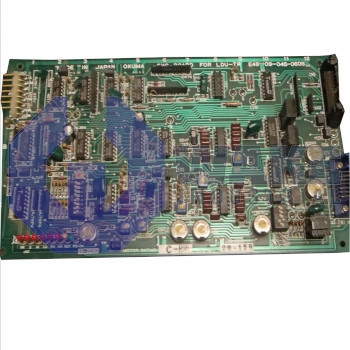
The Okuma E4809-045-122-C is an electrical control processor board from the E4809 CNC Boards series designed for the OSP 5020M control family. It features a 3.6 V lithium backup battery, 48 Kbyte S-RAM backup memory, and a main memory of 128 Kbyte D-RAM. The board operates with a 16-bit processor running at 15 MHz and has 2 F-Type encoder channels as well as 1 DA channel.


To contact sales for pricing and lead time:
Payment Methods


Shipping Methods


Our Credentials


Product Description:
The E4809-045-122-C is a CNC control board manufactured by Okuma for the E4809 CNC Boards series. Acting as the electrical control processor for machines in the OSP 5020M family, it executes motion commands and supervises feedback. It also maintains nonvolatile data so milling and turning centers can follow programmed tool paths without manual intervention.
The board’s computing core runs at a 15 MHz clock rate and operates on a 16-bit data path, pairing modest cycle time with wide instruction support for numerical control algorithms. Volatile workspace is provided by 128 Kbyte D-RAM, and this area stores real-time variables such as axis positions and interpolation results. Parameter retention after power loss is handled by 48 Kbyte S-RAM, so tool offsets and system settings remain intact between shifts. Communications to adjacent modules use the EC Bus IF, a backplane interface that moves axis, spindle, and I/O data across the controller rack with deterministic latency. A single D/A channel converts computed speed words into analog voltage for the spindle, while two F-type encoder inputs close the position loop for linear or rotary axes. One D-type servo drive channel dispatches torque references, matching the board to Okuma’s proportional-control amplifier topology.
Standby power for static memory and the real-time clock comes from a 3.6 V Lithium cell, eliminating the need for external UPS hardware during machine shutdowns. Position feedback is handled through 2 F-Type channels, allowing simultaneous monitoring of two primary axes without multiplexing. Command vectors flow to a D Type servo interface that drives incremental motor current loops, while spindle regulation is assigned to the VAC I inverter family selected for high-speed turning. One analog output channel is sufficient because the spindle signal is delivered as an analog voltage rather than a digital bus word, which helps keep conversion overhead low and preserves response time for rapid tool changes.









