


E4809-045-019-B Okuma
Wake Industrial LLC is not an authorized distributor of this product.
- Straightforward Pricing: No Rush Fees, No Credit Card Fees
Current response time:
6 Minutes
22 Seconds
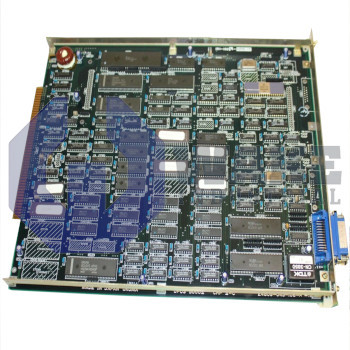
The Okuma E4809-045-019-B is part of the E4809 CNC Boards series and works with 3-phase input power at 200/220 V AC and 50/60 Hz. It is compatible with SDU-600W drives and is designed for DC spindle motors, using a full-wave back-to-back main circuit. This board supports current feedback through a current transformer, features two feedback loops, and includes three operation status LEDs.


To contact sales for pricing and lead time:
Payment Methods


Shipping Methods


Our Credentials


Product Description:
The E4809-045-019-B is a spindle-control circuit board manufactured by Okuma for the E4809 CNC Boards series. Installed inside an Okuma drive cabinet, the board interfaces between the machine controller and a dedicated spindle power unit to regulate a DC spindle motor’s torque and speed during cutting, tapping, or drilling. By monitoring motor feedback and issuing real-time commands, it maintains the commanded spindle profile required for consistent surface finish and tool life in automated machining operations.
The board is paired with the SDU-600W power converter and accepts a three-phase supply at 200/220 V AC and 50/60 Hz. Internally, it routes that input through a three-phase full-wave back-to-back main circuit so the attached drive can produce bidirectional current for acceleration, braking, and direction reversal. Two independent feedback loops close around current and velocity; the current loop uses a current transformer to sense armature flow, while the speed loop tracks tachometer voltage. This dual-loop structure enables rapid correction of load disturbances. Three operation status LEDs report power, run, and fault conditions, and regenerative braking is supported so excess kinetic energy is returned to the DC link instead of being dissipated as heat.
On the motor side, the board is tuned for a DC spindle motor. Armature control maintains a constant field up to base speed, then field weakening takes over from base speed to maximum speed to extend the spindle’s usable range. Velocity feedback is supplied by a tachogenerator, while precise position indexing for threading or rigid tapping relies on an optical pulse generator. The tachometer delivers a calibrated signal of 20 V/1000 rpm, allowing the controller to resolve speed changes in real time. Two feedback channels and support for field weakening help maintain stable regulation across the operating band without sacrificing torque at low speed.









