


E0451-521-094 Okuma
Wake Industrial LLC is not an authorized distributor of this product.
- Straightforward Pricing: No Rush Fees, No Credit Card Fees
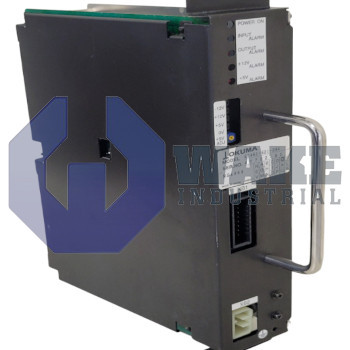
The Okuma E0451-521-094 is a power supply module from the E0451 Power Supply Boards series. It features positive and negative output rails of +12V and -12V, as well as a logic rail of +5V and a common rail at 0V. The module is compatible with OSP700L and OPUS 7000 control platforms and includes power, input alarm, output alarm, and voltage indicator lights on the front panel.


To contact sales for pricing and lead time:
Payment Methods


Shipping Methods


Our Credentials


Product Description:
The E0451-521-094 board belongs to the E0451 Power Supply Boards series manufactured by Okuma. This printed-circuit assembly functions as a power supply module that converts three-phase mains into regulated low-voltage rails required by OSP numerical controls. Installed in the electrical cabinet of a turning or milling center, the board delivers isolated DC power to logic, analog, and encoder interfaces so processors, spindle drives, and I/O cards receive consistent energy during moves, tool changes, and production cycles. Status lamps and pluggable connectors are integrated on the module, making power-rail conditions easier to monitor at the cabinet.
At the front edge, a trim potentiometer marked +5V ADJ allows the logic rail to be fine-tuned within ±50 mV of nominal. The reference node for every circuit is the common conductor held at 0V. Regulated +5 V, +12 V, and -12 V outputs exit through the DIN plug pair labeled XB1, XB2, which simplifies backplane wiring. The card interfaces directly with the OSP700L / OPUS 7000 control platform, so its alarm lines align with CPU expectations. Front indicators include the green Power On lamp, an amber Input Alarm, and a red Output Alarm that illuminate whenever rectifier current or a regulated line moves outside its allowable window. The +12 V and -12 V rails serve analog converters, while the +5 V rail supplies logic circuits.
The remaining indicators, +12V Alarm and +5V Alarm, are driven by separate comparators that sample each rail independently, so a disturbance on one supply does not mask a fault on the other. When either LED activates, the host OSP unit records a voltage error and initiates an orderly axis deceleration to protect servomotors and feedback devices. Because the board lacks active cooling, prompt response to these alarms helps limit heat buildup on the regulators.









