


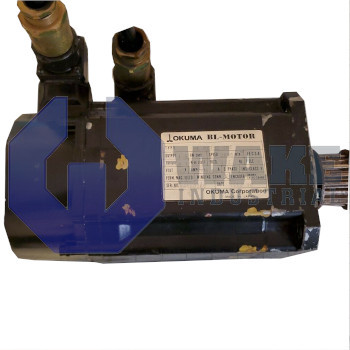
BL-MC95J-20TB Okuma
Wake Industrial LLC is not an authorized distributor of this product.
- Straightforward Pricing: No Rush Fees, No Credit Card Fees
Current response time:
6 Minutes
16 Seconds
The Okuma BL-MC95J-20TB is an AC servo motor from the BL Servo Motors series. It features a rated output of 2 kW, a rated speed of 2000 RPM, and provides 10.8 Newton meters of rated torque. The motor operates at 133 volts AC and is designed for three-phase systems with an M16 x 1.5 rod end thread.


To contact sales for pricing and lead time:
Payment Methods


Shipping Methods


Our Credentials


Product Description:
The BL-MC95J-20TB is an AC servo motor produced by Okuma as part of the BL Servo Motors series. In automated machining cells, this motor receives incremental command signals from a dedicated drive and turns them into precise shaft rotation that positions tables, tool carousels, or ancillary axes in real time. As a closed-loop actuator, it is intended for feed, traverse, and positioning axes across lathes, mills, and gantry systems. It is suitable for motion tasks that require repeatable response during starts, stops, and short indexing moves.
For electrical integration, the motor is assigned to the MIV02-1 single-axis amplifier, so the amplifier and motor use compatible current limits and resolver resolution. Its stator winding is configured for three-phase power, which helps maintain balanced phase relationships and smooth torque production when driven from a sinusoidal inverter. The motor is rated for 133 V AC, and at this voltage it delivers 2 kW of mechanical power. Continuous running speed is limited to 2000 rpm, allowing the bearing set to stay within thermal limits while still supporting high feed rates. These ratings establish operating limits for gear ratio selection, feedback scaling, and protective hardware.
The shaft can sustain a rated torque of 10.8 N·m, which is the continuous twisting effort available for cut forces or index motions without causing excessive winding temperature rise. Output hardware mates to a female thread sized M16 × 1.5, simplifying coupling to lead screws or precision gear hubs without additional adapters. The threaded output also helps secure attached components during repeated reversing motion on precision axes. These values can be used with stored inertia data in the controller to set suitable acceleration profiles and keep the motor within its thermal and mechanical limits during demanding duty cycles.