


MX2000-2A Kollmorgen
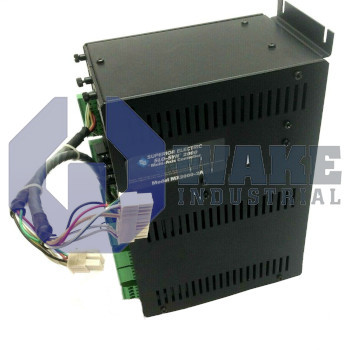
Wake Industrial LLC is not an authorized distributor of this product.
- Straightforward Pricing: No Rush Fees, No Credit Card Fees
The Kollmorgen MX2000-2A is a motion controller from the MX2000 Motion Controllers series. It supports two axes, has 4 analog inputs, 2 analog outputs, and features 16 optically isolated digital inputs along with 8 optically isolated digital outputs. The controller is equipped with a TMS320C31 32-bit 33 MHz DSP processor, 256 Kbytes flash memory, and includes two encoder interfaces with a maximum count rate of 2 MHz.


To contact sales for pricing and lead time:
Payment Methods


Shipping Methods


Our Credentials


Product Description:
Kollmorgen's MX2000-2A is a motion controller in the MX2000 Motion Controllers series. It functions as the central command device that receives machine instructions and produces synchronized position, velocity, and timing outputs for connected drives and feedback loops in industrial automation. The unit mounts inside a control cabinet, links to amplifiers with differential command signals, and uses a dedicated real-time kernel to maintain deterministic loop timing even when machine workloads fluctuate.
The controller handles 2 axes with hardware support from a TMS320C31, 32-bit, 33 MHz DSP that executes servo algorithms and up to 7 concurrent tasks in real time. Program code and motion tables are stored in 256 Kbytes of flash memory, while RAM allocation preserves sixteen nested subroutine levels for complex sequencing. Machine interaction is provided by 4 analog inputs, 2 analog outputs, 16 optically isolated digital inputs, and 8 similarly isolated digital outputs, so analog sensing and discrete event processing can run in parallel. Two encoder interfaces and a pair of serial ports allow incremental feedback and operator terminal connections without external expanders.
The I/O section draws 0.75 A from a 24 VDC field supply, so large external relays can be driven without exceeding on-board regulators. High-speed motion demands are met by a maximum encoder count rate of 2 MHz and a step-and-direction pulse capability of 1.99 MHz, enabling precise following error detection and open-loop stepper control at nearly two million steps per second. Communication to HMIs or upstream PLCs stays deterministic up to 38.4 Kbaud on either serial channel, and each axis can still process feedback because the controller accepts encoder frequencies and generates step pulses independently of the serial task load.