


BH-126-B-99-E106-062 Kollmorgen
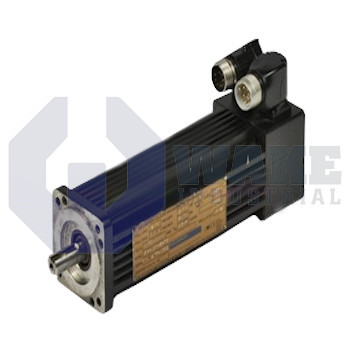
Wake Industrial LLC is not an authorized distributor of this product.
Wake Industrial LLC is not an authorized distributor of this product.
The Kollmorgen BH-126-B-99-E106-062 servo motor is part of the Goldline B and BH Motors series. It delivers a continuous power of 1.2 kW with a rated speed of 7500 rpm and a continuous rated torque of 1.47 N·m. The motor features a resolver feedback type and a thermostat that opens at 170°C and closes at 132°C.
Internal Product Review
The BH-126-B-99-E106-062 is a Kollmorgen servo motor with 1.2 kW continuous power and a 7500 rpm rated speed. Resolver feedback and 4.2 N·m peak stall torque give this unit strong motion accuracy and confident dynamic response. A highly capable Goldline motor for demanding axes, highlighted by 1.47 N·m continuous rated torque.
 Have a part to sell?
 Wake Industrial Warranty
To contact sales for pricing and lead time:
Payment Methods


Shipping Methods


Our Credentials


Product Description:
The BH-126-B-99-E106-062 is a brushless servo motor produced by Kollmorgen as part of the Kollmorgen Goldline B and BH Motors series. This motor converts electrical input into tightly regulated rotary motion for positioning tables, gantry axes, and other precision loads in automated equipment. Its compact frame allows direct coupling to gearheads or belts. The design also works smoothly with matched digital drives to maintain accurate velocity and torque during repeated starts, stops, and load changes.
The motor draws a continuous phase current of 2.6 ARMS, a value that supports 1.2 kW of continuous mechanical output without overheating. Under this current, the shaft can supply a continuous torque of 1.47 N·m. At a rated speed of 7500 rpm, the drive line can reach high linear velocities on direct-drive stages. The phase-to-phase inductance of 37.6 mH shapes current rise times and assists the controller in suppressing ripple. Resolver feedback provides analog sinusoidal position data for real-time commutation, allowing the paired drive to track rotor position as load conditions change. When brief overload is required, the motor can deliver a peak torque of 4.07 N·m. Its continuous stall torque is 1.9 N·m, which helps the axis resist steady loads while stopped.
Additional performance margins appear in a peak stall current of 6 ARMS and a peak stall torque of 4.2 N·m, giving headroom for rapid accelerations. A rotor inertia of 0.0000765 kg·m² helps the motor reverse quickly on axes that change direction frequently. Thermal protection is handled by an embedded thermostat with switching points at 132 °C and 170 °C. Its contacts are normally closed and carry up to 4 A at 120 VAC, so the protection circuit can connect directly to shutdown inputs. This arrangement lets the control system react to rising motor temperature before prolonged overload causes damage.









