


digifas 7108 Kollmorgen
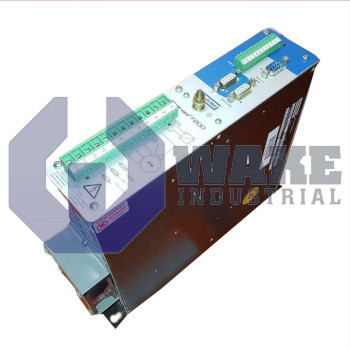
Wake Industrial LLC is not an authorized distributor of this product.
- Straightforward Pricing: No Rush Fees, No Credit Card Fees
The Kollmorgen digifas 7108 is a servo amplifier from the DIGIFAS 7000 Servo Amplifiers series with a rated output current of 8 Arms and a peak output current of 16 Arms. It features an intermediate circuit voltage of 560 V DC and a power loss at rated current of 100 W. The amplifier has a setpoint resolution of 14-bit and is protected to IP20 class.


To contact sales for pricing and lead time:
Payment Methods


Shipping Methods


Our Credentials


Product Description:
The digifas 7108 is a servo amplifier produced by Kollmorgen within the DIGIFAS 7000 Servo Amplifiers series. It serves as the interface between a motion controller and a three-phase servo motor, shaping current and voltage so the motor follows programmed speed or torque commands in automated machinery. The unit is intended for closed-loop motion tasks where stable motor response is required during positioning and speed control. It is suitable for cabinet-mounted drive systems that rely on coordinated electrical feedback and controlled current delivery.
This unit operates on an intermediate circuit potential of 560 V DC. Its current loop responds at up to 1 kHz, allowing tight dynamic control, and a rated phase output of 8 Arms supports continuous motion. The high-frequency output stage clocks at 8.33 kHz, which helps reduce ripple in the motor windings. Command values enter with 14-bit resolution, giving 16,384 discrete setpoints for fine positioning. Digital inputs draw 7 mA and have 20 kΩ of input resistance, so standard PLC cards can drive them directly. The amplifier requires motors with at least 5 mH of inductance to avoid overcurrent spikes. During normal loading, it dissipates 100 W as heat and carries a connected load of 4.5 kVA. A residual voltage drop of 5 V appears across the output stage, and the enclosure has an IP20 rating for cabinet installation.
Transient demands can be met with a peak current of 16 Arms for rapid acceleration. When the DC bus rises above the ballast switch-on point of 720 V, surplus energy is routed to an internal resistor that can absorb 200 W. Should the link voltage climb further, an overvoltage shutdown triggers at 750 V to protect the semiconductors. This ballast action helps manage returned energy during deceleration and other regenerative events.









