


VT-UK2-3X/VT13216A/U209 Bosch Rexroth Indramat
Wake Industrial LLC is not an authorized distributor of this product.
Wake Industrial LLC is not an authorized distributor of this product.
MPN: R900953324
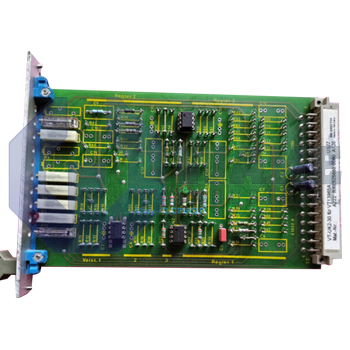
Ask for AvailabilityThe Bosch Rexroth Indramat VT-UK2-3X/VT13216A/U209 is part of the VT-UK2 Universal Cards series and uses a Eurocard format with dimensions of 100 x 160 mm. It features a blade connector with DIN 41 612 standard, operates with a 10 V input and output signal, and includes 6 operational amplifiers arranged in 3 double op amp configurations. The card is equipped with 5 null point potentiometers and incorporates regulator, invertor, and summator functional blocks, along with Schmitt-trigger and differentiator logic blocks.
Internal Product Review
The VT-UK2-3X/VT13216A/U209 is a Bosch Rexroth Indramat universal card in Eurocard format. Regulator and summator functions pair well with Schmitt-trigger and differentiator logic, giving this card a very capable analog control profile. The 5 null-point potentiometers make calibration especially convenient, which is a strong advantage in precision tuning.
 Have a part to sell?
 Wake Industrial Warranty
To contact sales for pricing and lead time:
Payment Methods


Shipping Methods


Our Credentials


Product Description:
The VT-UK2-3X/VT13216A/U209 is a plug-in signal-processing board from Bosch Rexroth Indramat and belongs to the VT-UK2 Universal Cards series. It is intended for mounting in standardized racks. In that role, it conditions analog feedback and command voltages used by hydraulic or motion controllers.
This board adopts the Eurocard profile, providing a standard footprint of 100 x 160 mm that slides straight into 19-inch rack guides. Interface contacts are grouped on a Blade connector that follows DIN 41 612, permitting quick removal from a cabinet without disturbing adjacent wiring. Supply power arrives at 10 V, and the output stage provides the same magnitude so downstream electronics receive a matched reference. Internally, three dual operational-amplifier packages implement regulator, inverter, and summing blocks, while discrete resistors set individual loop gains and polarity. The layout keeps high-frequency tracks short to limit noise pickup, and plated through-holes support mechanical rigidity during vibration. Separate test points provide direct access to the reference and feedback nodes for adjustment and verification.
Digital conditioning is handled by a Schmitt-trigger for clean edge regeneration and a Differentiator that produces rate signals for phase-lead correction. These logic functions share the array of 6 operational amplifiers, allowing mixed analog and digital handling without extra silicon. Front-panel access is provided through 5 potentiometers of the null-point type, and centering any knob restores zero offset for straightforward adjustment. The op-amp pairs are wired in close proximity to their passive networks to minimize propagation delay, while identical reference levels on input and output help prevent saturation when several cards are cascaded. By combining multiple functional blocks on one board, the module reduces slot usage in compact hydraulic drive stations.









