


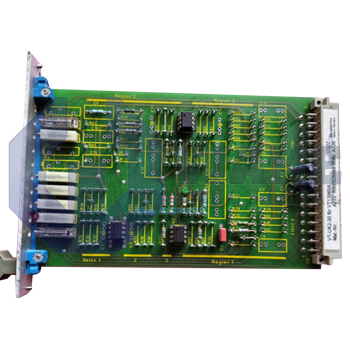
VT-UK2-3X/VT11350A/U154 Bosch Rexroth Indramat
Wake Industrial LLC is not an authorized distributor of this product.
MPN: R900552292
No Tariffs On US Orders- Straightforward Pricing: No Rush Fees, No Credit Card Fees
Current response time:
3 Minutes
25 Seconds
The Bosch Rexroth Indramat VT-UK2-3X/VT11350A/U154 is part of the VT-UK2 Universal Cards series and features six operational amplifiers with a Eurocard format sized at 100 by 160 millimeters. It uses a DIN 41 612 blade connector and is designed for a 19 inch rack with an input voltage of 10 volts.


To contact sales for pricing and lead time:
Payment Methods


Shipping Methods


Our Credentials


Product Description:
The VT-UK2-3X/VT11350A/U154 universal card is produced by Bosch Rexroth Indramat for the VT-UK2 Universal Cards series. Designed for automation cabinets, the board provides analog interface functions between field devices and motion controllers, allowing process variables to be scaled, filtered, or summed before they reach higher-level logic. By plugging into a standardized rack, the module gives system builders a flexible way to implement custom analog conditioning without redesigning the entire control backplane.
The board occupies a printed-circuit area of 100 × 160 mm, a footprint that follows IEC rack dimensions used in modular control systems. Its mechanical outline uses the Eurocard format, so guide rails, ejector handles, and grounding strips can be shared with other control cards. Electrical interfacing is handled through a rear plug built to the DIN 41 612 standard, supporting pin compatibility with many backplanes. Signal conditioning stages are powered from a reference of 10 V, and the processed analog channel is delivered as a stable 10 V at 5 mA output for direct connection to drive controllers or PLC analog inputs without additional buffering.
For reliable field use, the card operates across an ambient range of 0 to +50 °C, allowing it to share enclosures with power components that raise cabinet temperatures. Internally, 6 operational amplifiers are distributed across the circuit, giving users multiple summing, inverting, or differential stages that can be wired through jumpers for application-specific gain structures. A front-edge blade connector mates with panel test leads so signals can be probed or injected without extracting the module from its assigned 19-inch rack. This arrangement helps preserve access to the card while the rest of the rack remains in place.