


VT-UK2-3X/ES-E61-A002/U161 Bosch Rexroth Indramat
Wake Industrial LLC is not an authorized distributor of this product.
Wake Industrial LLC is not an authorized distributor of this product.
MPN: R900906794
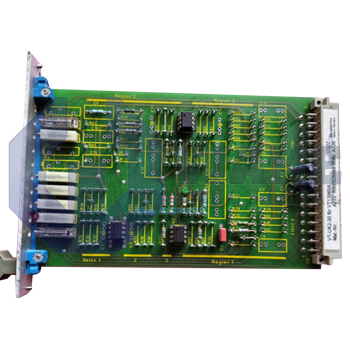
Ask for AvailabilityThe Bosch Rexroth Indramat VT-UK2-3X/ES-E61-A002/U161 is a Eurocard-format card from the VT-UK2 Universal Cards series, measuring 100 x 160 mm and built to the DIN 41 494 standard. It features soldered junctions, a blade connector (DIN 41 612), operates with an input voltage of 10 V, and provides five null point potentiometers and six operational amplifiers.
Internal Product Review
The VT-UK2-3X/ES-E61-A002/U161 is a Bosch Rexroth Indramat universal card built in a Eurocard format with a blade connector interface. With 6 operational amplifiers and a 10 V output signal, this card supports precise signal handling in control applications. A well-executed choice for stable and efficient analog control integration.
 Have a part to sell?
 Wake Industrial Warranty
To contact sales for pricing and lead time:
Payment Methods


Shipping Methods


Our Credentials


Product Description:
The VT-UK2-3X/ES-E61-A002/U161 universal card is produced by Bosch Rexroth Indramat within the VT-UK2 Universal Cards series. It plugs into modular control racks found in presses, test rigs, and general automation cabinets, providing a flexible way to scale analog I/O without redesigning the backplane. By routing conditioned reference and feedback signals through standardized connectors, the card bridges the gap between a central controller and decentralized hydraulic or electric actuators.
The card follows the Eurocard format and occupies the standard 100 x 160 mm footprint, permitting straightforward insertion into 3U subracks. Compliance with the DIN 41 494 card standard sets board thickness and guide-rail clearances, so mixed installation with other control cards is possible without spacers. Field wiring reaches the circuitry through a blade connector on the front edge, while mating racks use connectors that follow the DIN 41 612 coding scheme for keyed engagement. All internal components are joined by soldered junctions, which helps stabilize signal paths against vibration and repeated insertion cycles. The arrangement supports repeatable contact resistance after repeated card removal and reinsertion.
Electrically, the board is energized by a regulated reference of 10 V, and that reference sets the full-scale span of its ±10 V output channel. Upstream processing is handled by 6 low-noise operational amplifiers that provide gain, inversion, and buffering functions before the conditioned signal leaves the card. To trim offset errors originating from sensor tolerances, the design offers 5 null-point potentiometers that allow each amplifier stage to be recentered with a small screwdriver. The final driver can source up to 5 mA, enough to feed high-impedance control inputs in servo valves or analog drive modules while holding the nominal output level. The card provides stable signal conditioning throughout the control cabinet.