


DLF1.1 Bosch Rexroth Indramat
Wake Industrial LLC is not an authorized distributor of this product.
- Straightforward Pricing: No Rush Fees, No Credit Card Fees
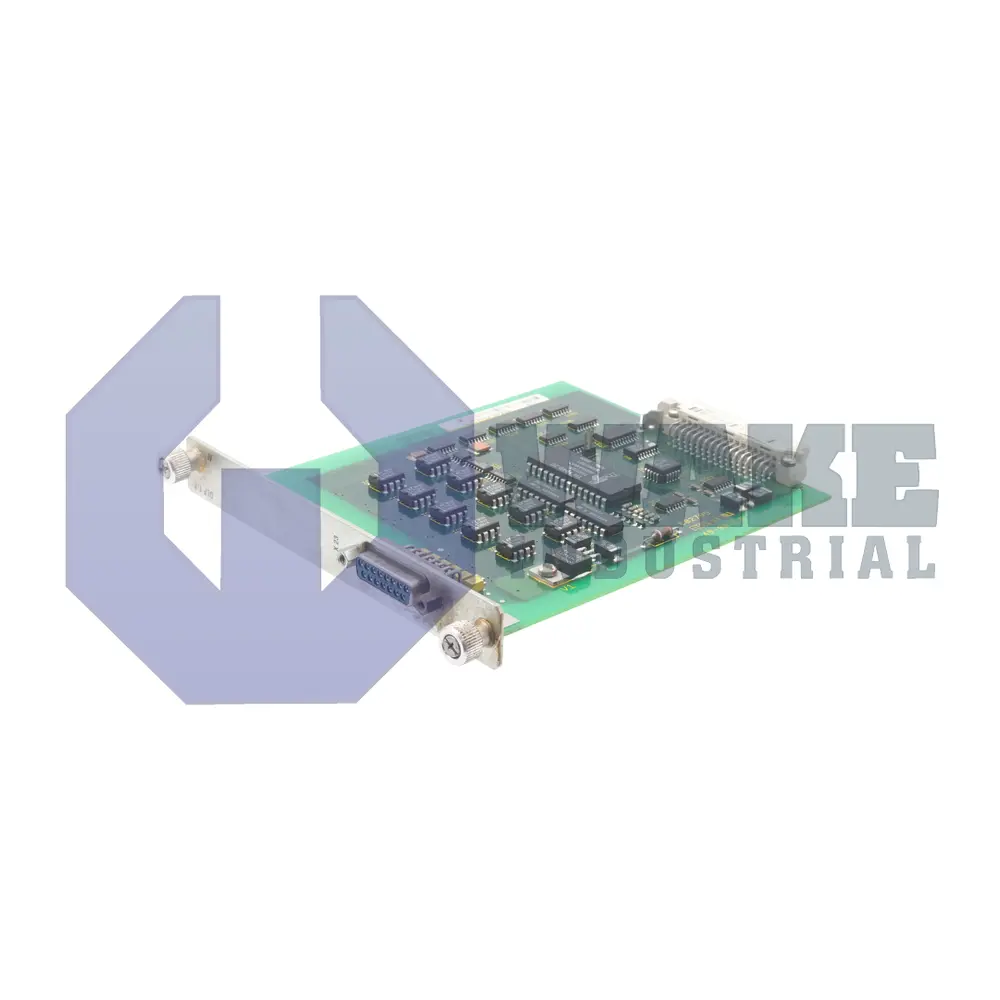
The Bosch Rexroth Indramat DLF1.1 is part of the VT-UK2 Universal Cards series and uses a 15-pin D-SUB connector with screw mounting. It has a signal resolution of 2048-fold, a maximum output current of 150 mA, and supports signal frequencies up to 500 kHz for voltage signals with a 50 meter cable length.


To contact sales for pricing and lead time:
Payment Methods


Shipping Methods


Our Credentials


Product Description:
The DLF1.1 module is manufactured by Bosch Rexroth Indramat as part of the VT-UK2 Universal Cards series. It operates as an intermediary board that receives analog sine feedback, applies filtering and termination, and then forwards conditioned information to higher-level motion or process controllers. By supporting both current- and voltage-based signaling paths, the card helps integrate sensors located at varying distances from the cabinet and adapt to different encoder output methods. It also maintains phase integrity between the complementary A and B tracks that form a quadrature pair before the signals reach the receiving electronics.
Field wiring reaches the board through a 15-pin D-SUB connector secured by screw mounting. Voltage-mode feedback can travel up to 30 m when the remote device outputs a 1 VSS signal amplitude, and the card preserves signal fidelity up to 500 kHz. Quadrature timing between the A and B channels is maintained at 90 electrical degrees, allowing the downstream controller to multiply each electrical cycle into a 2048-fold position count. When the application uses a current loop, the companion channel supports the same cable reach and a maximum carrier of 150 kHz while keeping the same phase relationship. An onboard 121 Ω termination resistor matches typical line impedance so that reflections are minimized along shielded twisted pairs.
The conditioning stage provides a regulated DC +5 V (±5%) supply for external sensing heads, sourcing up to 150 mA through the connector. Input noise is attenuated by a filter network that combines 10 nF of shunt capacitance with 1 µH of series inductance, limiting conducted transients before the comparator stage. Once filtered, the reference track can be clocked as high as 15 kHz for coarse monitoring, or the full sine channels can be decoded at 2048 times this base frequency for precision movement control. This arrangement helps the board present encoder feedback in a form that can be processed directly by connected control electronics without additional external conditioning.
Frequently Asked Questions about DLF1.1:
Q: What is the maximum output current available on the DLF1.1 card?
A: The DLF1.1 universal card supports a maximum output current of 150 mA.
Q: What type of connector does the DLF1.1 use?
A: The DLF1.1 is equipped with a 15-pin D-SUB connector for signal and power connections.
Q: What is the maximum frequency for voltage signal inputs on the DLF1.1?
A: The voltage signal input on the DLF1.1 can operate at frequencies up to 500 kHz.
Q: What is the resolution capability of the DLF1.1 card?
A: This card offers a resolution of 2048-fold for signal processing.
Q: What is the maximum cable length allowed for current signals on the DLF1.1?
A: The maximum allowable cable length for current signals on the DLF1.1 is 30 meters.









