


RKG0006 Bosch Rexroth Indramat
Wake Industrial LLC is not an authorized distributor of this product.
MPN:
No Tariffs On US Orders- Straightforward Pricing: No Rush Fees, No Credit Card Fees
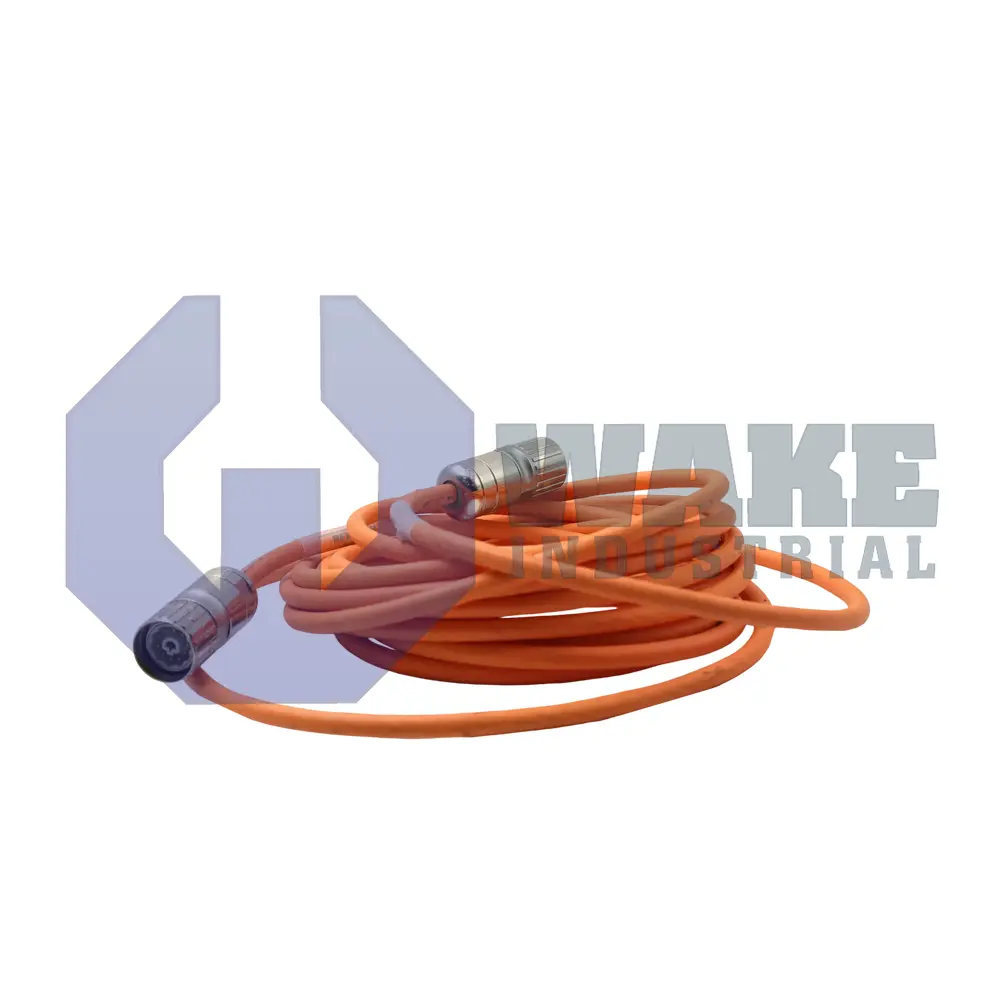
The Bosch Rexroth Indramat RKG0006 is an encoder cable from the RKG Encoder Cables series with a bulk cable type of INK0532 and supports up to 5,000,000 bending cycles. It features an M23 connector with 17 crimp contacts on one end and a D-sub connector with 15 solder contacts and a 2x45° exit on the other.


To contact sales for pricing and lead time:
Payment Methods


Shipping Methods


Our Credentials


Product Description:
The RKG0006 encoder cable is produced by Bosch Rexroth Indramat within the RKG Encoder Cables series. It links motor or axis-mounted transducers to Rexroth drive electronics, forwarding differential encoder signals while tolerating flexing common in gantry and articulated robot axes. Factory-terminated connectors on both ends allow quick installation and consistent shielding integrity across production lines.
The signal conductors are bundled in the INK0532 bulk cable, a finely stranded formulation suited for continuous motion. Its jacket and core design survives 5,000,000 bending cycles without conductor fatigue, provided the dynamic routing observes a minimum loop of 7.5xD. At the motor side, connector INS0379 is fitted; this M23 shell carries a crimped socket array that presents 17 signal positions. The circular geometry and threaded coupling of M23 simplify strain relief and provide 360-degree shielding continuity. Together, these attributes let the cable follow tight linear tracks and rotary joints while maintaining low-noise transmission.
Controller termination uses connector INS0761, a 15-pole D-sub with a solder socket layout oriented at 2x45° to clear adjacent hardware. The pin field offers 15 discrete channels for incremental, serial or absolute encoder protocols, and the metal hood mates to the drive enclosure to extend the braid shield. Static routing that complies with a bend radius of 5xD prevents compression set in the insulation when the harness is fixed to cabinet walls or drag-chain segments. Combined with the soldered contacts and the rated cycle life, these features ensure reliable position feedback over the machine’s service interval without mid-span splices or intermittent dropouts.