


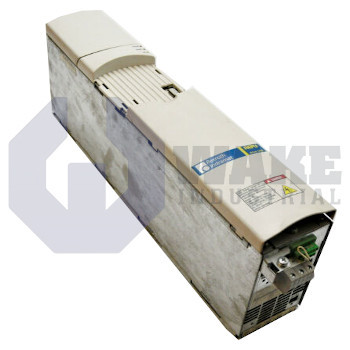
RD51.1-5B-001-L-NN-FW Bosch Rexroth Indramat
Wake Industrial LLC is not an authorized distributor of this product.
MPN: R911200740
No Tariffs On US Orders- Straightforward Pricing: No Rush Fees, No Credit Card Fees
The Bosch Rexroth Indramat RD51.1-5B-001-L-NN-FW is a drive controller from the RD 500 Drive Controllers series. It features a built-in brake chopper and uses U/f curve control. The device operates with forced air cooling and takes a 3-phase AC supply at 500 volts.


To contact sales for pricing and lead time:
Payment Methods


Shipping Methods


Our Credentials


Product Description:
The RD51.1-5B-001-L-NN-FW drive controller is produced by Bosch Rexroth Indramat for the RD 500 Drive Controllers series. Built as a stand-alone converter unit, it converts three-phase AC line power into a regulated output for induction motors. The controller provides adjustable-speed operation so machine sections can ramp, hold, and reduce motor speed in a controlled way during process changes. This makes it suitable for duties such as material transport, airflow control, and pump regulation where smooth speed adjustment is more important than high-precision servo positioning.
It uses a three-phase AC input and is sized for mains supplies up to 500 V. Motor speed is regulated through U/f curve control, which maintains the relationship between stator voltage and frequency across the operating range. This control method is well suited to applications that need dependable speed variation without closed-loop vector feedback. Heat is removed by forced air cooling, so the installation should allow clear airflow around the power section to support stable temperature control. During deceleration, a built-in brake chopper dissipates regenerated energy and helps prevent DC-bus overvoltage when the motor is slowing a driven load.
The unit is in design generation 1, so its hardware layout follows early RD51 mounting dimensions and terminal positions. Functional expansion slots are present, but they are not equipped, which leaves room for application-specific option cards when additional interfaces are needed. This arrangement allows the base controller to remain focused on core speed-control tasks while still supporting later configuration changes. It also gives the drive a straightforward layout for systems that need standard power conversion first and optional communication or feature expansion afterward.