


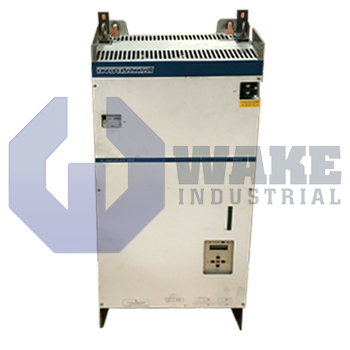
RAC 2.2-150-380-A0D-W1 Bosch Rexroth Indramat
Wake Industrial LLC is not an authorized distributor of this product.
Wake Industrial LLC is not an authorized distributor of this product.
MPN: R911238299
Ask for AvailabilityThe Bosch Rexroth Indramat RAC 2.2-150-380-A0D-W1 is an AC main spindle drive controller from the RAC Spindle Drive Controllers series. It supports a rated connection voltage of 3 x AC 400 V at 50-60Hz, delivers a rated current of 150 Amps, and has an internal blower for cooling. The unit features a digital position set-point interface and provides an analog speed command of plus or minus 10 Volts.
Internal Product Review
The RAC 2.2-150-380-A0D-W1 is an AC main spindle drive controller rated for 3 x AC 400 V input and 150 A current capacity. The 16-bit parallel digital position set-point interface works well with the analog ±10 V speed command for accurate spindle integration and responsive control. Built-in blower cooling adds dependable thermal management, making this controller a strong choice for demanding spindle applications.
 Have a part to sell?
 Wake Industrial Warranty
To contact sales for pricing and lead time:
Payment Methods


Shipping Methods


Our Credentials


Product Description:
The RAC 2.2-150-380-A0D-W1 is an AC main spindle drive controller made by Bosch Rexroth Indramat for the RAC Spindle Drive Controllers series. It governs induction or synchronous spindles in machine tools, transforming plant power into regulated output that maintains commanded speed and torque. Integrated monitoring and parameter memory allow the drive to sustain stable spindle performance during continuous machining, thread cutting, and finishing operations in automated production cells. This operating profile suits applications where spindle speed must remain consistent during load changes caused by cutting depth, material variation, or rapid deceleration between machining steps.
Electrical integration begins with a supply rating of 3 × AC 400 V, 50–60 Hz, fitting common industrial mains in Europe and North America. From this input, the inverter can continuously source 150 A, enough to accelerate heavy work-holding systems and spindle masses without requiring oversized auxiliary equipment. Heat created by switching losses is removed through a built-in fan, so the controller does not rely on external ductwork for basic cooling. The spindle controller accepts a bipolar velocity reference over an analog (±10 V) channel, allowing legacy CNC cards to command speed changes directly. Control, enable, and fault lines converge on the 9-pole X4 connector, which keeps low-voltage connections grouped in one interface.
As a hardware platform of version 2, the controller also includes a parallel bus that receives a 16-bit digital position setpoint for synchronized tapping or contour milling where speed and position must transition smoothly. The drive is supplied without an additional encoder input, so all incremental feedback connects through the primary spindle channel. It is also supplied without an additional bleeder, so regenerated energy is handled by the internal braking arrangement during controlled deceleration. This layout keeps external components to a minimum and leaves more cabinet space available for neighboring modules.