


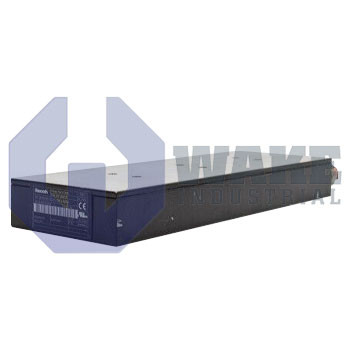
MLP140A-0120-FS-N0CD-NQNN Bosch Rexroth Indramat
Wake Industrial LLC is not an authorized distributor of this product.
MPN: R911370329
No Tariffs On US Orders- Straightforward Pricing: No Rush Fees, No Credit Card Fees
The Bosch Rexroth Indramat MLP140A-0120-FS-N0CD-NQNN is part of the MLP Synchronous Linear Motors series and features a 1680 Newton continuous nominal force with a maximum force of 5200 Newtons. It is designed with liquid cooling, has a rated current of 12.1 Amps, and its primary part mass is 17 Kilograms. The motor offers a nominal velocity of 190 meters per minute and supports a force constant of 138.5 Newtons per Amp.


To contact sales for pricing and lead time:
Payment Methods


Shipping Methods


Our Credentials


Product Description:
The MLP140A-0120-FS-N0CD-NQNN linear motor primary section is produced by Bosch Rexroth Indramat for the MLP Synchronous Linear Motors series. Designed as the thrust-generating element of a linear drive, it replaces rotary motors and mechanical transmissions to deliver direct linear motion to tooling, gantries, or material-handling axes in automated equipment. Because no encoder is installed, an external feedback device must be mounted on the machine for closed-loop positioning.
This primary part delivers a continuous nominal force of 1680 N, enabling steady feed at the specified nominal velocity of 190 m/min without overheating. When short bursts are needed, the winding can generate a maximum force of 5200 N, allowing rapid acceleration of loads within structural limits. The rated current of 12.1 A is the RMS phase current required to reach the nominal force, while the drive may supply up to 70.8 A for peak operation. A force constant of 138.50 N/A links commanded current to output thrust, which simplifies current-loop tuning in the drive controller. Attractive force toward the secondary track is 7500 N, so guidance elements must withstand that load. At maximum force, the mover reaches 120 m/min, and power loss is 1300 W that must be removed by the integrated cooling circuit.
Heat is extracted through liquid cooling; the channel tolerates inlet pressures up to 10 bar and needs at least 1.9 l/min of flow to keep the coil temperature within limits. With this method, the active parts reach thermal equilibrium after a short 2.4 min time constant, so force transients settle quickly. A voltage constant of 79.9 Vs/m characterizes the back EMF developed at speed and helps with inverter sizing. Electrical losses are influenced by the winding inductivity of 23.1 mH and a winding resistance of 4.3 Ω, which affect current ripple and copper heating. The 17 kg primary mass and standard encapsulation technique add stiffness without excessive payload.









