


MDD065D-N-040-N2M-095GB0 Bosch Rexroth Indramat
Wake Industrial LLC is not an authorized distributor of this product.
MPN: R911255791
No Tariffs On US Orders- Straightforward Pricing: No Rush Fees, No Credit Card Fees
Current response time:
5 Minutes
29 Seconds
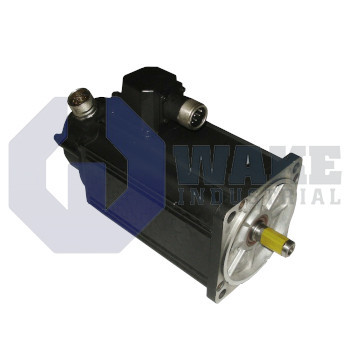
The Bosch Rexroth Indramat MDD065D-N-040-N2M-095GB0 is a motor for digital drive controllers and is part of the MDD Synchronous Motors series. This model features a nominal speed of 4000 rpm and delivers a continuous torque at standstill of 2.7 Nm. It comes with an integrated multiturn absolute encoder, has a centering diameter of 95 mm, and uses a plain shaft with a shaft seal.


To contact sales for pricing and lead time:
Payment Methods


Shipping Methods


Our Credentials


Product Description:
The MDD065D-N-040-N2M-095GB0 is a synchronous servo motor produced by Bosch Rexroth Indramat for the MDD Synchronous Motors series. Designed to work with compatible digital drive controllers, the unit supplies controlled torque and speed to automated axes in packaging, handling, and light machining equipment. Its integrated multi-turn absolute encoder sends position data back to the controller, allowing precise closed-loop motion for coordinated multi-axis operation in industrial automation systems. This feedback arrangement helps the drive maintain position accuracy during indexing, speed changes, and repeated start-stop cycles.
A centering diameter of 95 mm aligns the motor face to machinery, and all power and feedback connections exit on side B to simplify cable routing in narrow cabinets or machine frames. A plug-in connector system accepts pre-made cables, which helps keep installation orderly and reduces wiring complexity at the motor. At standstill, the motor sustains 2.7 Nm of continuous torque, giving stable holding force for positioning tables or tensioning systems. When driven by a compatible inverter, the rotor reaches a nominal speed of 4000 rpm, supporting fast cycle rates on pick-and-place axes and similar motion tasks. A shaft seal at the output end helps block splash contaminants, while the standard housing and balanced rotor support smooth running during extended duty.
The motor is built in size 065 with length code D, giving a compact form that suits installations where mounting space is limited. Power is transmitted through a plain shaft, which is suitable for couplings or pulleys that do not require a keyed connection. The motor is supplied without a blocking brake, so any load-holding function during power-off conditions must be provided by external clamping or by the drive system. Digital servo feedback and the multi-turn encoder preserve absolute position information after shutdown, while the standard balancing and sealed shaft end support stable operation and low mechanical disturbance during repeated motion.
Frequently Asked Questions about MDD065D-N-040-N2M-095GB0:
Q: What type of encoder is integrated into the MDD065D-N-040-N2M-095GB0 motor?
A: This model includes an integrated multiturn absolute encoder for precise position feedback.
Q: What is the continuous torque at standstill for the MDD065D-N-040-N2M-095GB0?
A: The MDD065D-N-040-N2M-095GB0 delivers a continuous torque of 2.7 Nm at standstill.
Q: Does the MDD065D-N-040-N2M-095GB0 motor include a holding brake?
A: This motor does not come equipped with a blocking brake.
Q: What is the connection direction and type of the MDD065D-N-040-N2M-095GB0?
A: The connection for this motor is located on Side B and uses a connector type.
Q: What type of shaft and seal does the MDD065D-N-040-N2M-095GB0 motor have?
A: This model features a plain shaft with a shaft seal to protect against contaminants.