


MDD025A-N-100-N2G-040MD1 Bosch Rexroth Indramat
Wake Industrial LLC is not an authorized distributor of this product.
- Straightforward Pricing: No Rush Fees, No Credit Card Fees
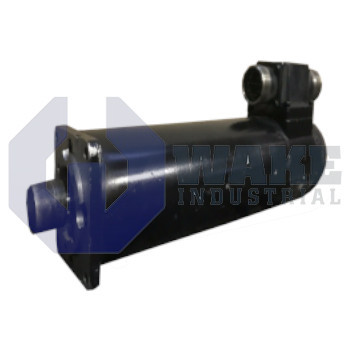
The Bosch Rexroth Indramat MDD025A-N-100-N2G-040MD1 is part of the MDD Synchronous Motors series and is a motor designed for digital drive controllers. This model features a nominal speed of 10000 rpm and has a continuous torque at standstill of 0.33 Nm. It includes a holding brake with a torque of 1.0 Nm and uses resolver feedback.


To contact sales for pricing and lead time:
Payment Methods


Shipping Methods


Our Credentials


Product Description:
The MDD025A-N-100-N2G-040MD1 is a synchronous servo motor manufactured by Bosch Rexroth Indramat within the MDD Synchronous Motors series. It is intended for use with digital drive controllers and converts commanded current into precise rotary motion for light-duty axes that demand high-speed positioning. Size 025 and length code A give this unit a compact frame suitable for pick-and-place heads, small conveyor spindles, or tool changers where installation space is restricted. The low moving mass of this frame size also supports quick response in applications that depend on short cycle times.
The motor provides a continuous standstill torque of 0.33 Nm, allowing the shaft to hold load without overheating at rated temperature. The rotor reaches a nominal speed of 10000 rpm, so the axis can sustain rapid production cycles. A blocking brake is integrated and supplies 1.0 Nm of torque to secure the load whenever power is removed. Position information is delivered through resolver feedback, giving the controller rotor angle data during operation. Electrical power and signal conductors are routed through a connecting cable with a coupling unit, which keeps the connection arrangement compact and easy to route in modular machine frames.
All terminals face Side B, keeping cable access on one side of the machine. The front flange provides a centering recess of 40 mm, allowing repeatable mounting concentricity to gearheads or adapters. Torque is transferred through a keyway on the single shaft end, and lubricant exclusion is handled at the machine side because the motor is supplied without a shaft seal. Standard balancing and housing geometry help keep vibration low during operation. The single shaft end also reduces mechanical complexity and suits compact drive arrangements where only one output connection is required.









