


MDD025A-N-100-N2G-040GE1 Bosch Rexroth Indramat
Wake Industrial LLC is not an authorized distributor of this product.
- Straightforward Pricing: No Rush Fees, No Credit Card Fees
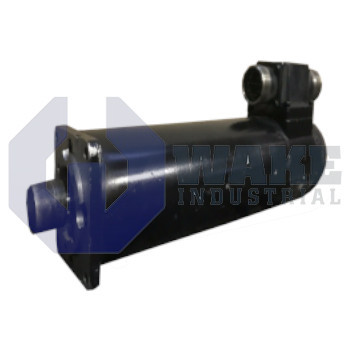
The Bosch Rexroth Indramat MDD025A-N-100-N2G-040GE1 is part of the MDD Synchronous Motors series and is intended for use with digital drive controllers. This motor features a nominal speed of 10000 rpm, a continuous torque at standstill of 0.33 Nm, and comes equipped with a blocking brake providing 1.0 Nm holding torque. It includes resolver feedback, a 40 mm centering diameter, and a standard plain shaft with shaft seal.


To contact sales for pricing and lead time:
Payment Methods


Shipping Methods


Our Credentials


Product Description:
The MDD025A-N-100-N2G-040GE1 is a synchronous AC motor produced by Bosch Rexroth Indramat within the MDD Synchronous Motors series. It is intended for direct connection to digital drive controllers, where it provides controlled rotary motion for compact automation axes. This arrangement lets the drive regulate torque, speed, and position in small handling modules, feed units, and other light machine functions. The motor uses size 025 with length code A, giving it a small frame that fits tight mounting spaces without adding unnecessary bulk.
It delivers a continuous standstill torque of 0.33 Nm, allowing stable holding and fine positioning while the axis remains energized. Under rated excitation it reaches a nominal mechanical speed of 10,000 rpm, which suits light-duty processes that need fast motion over short travel distances. A blocking brake rated at 1.0 Nm keeps the shaft locked when power is removed, which helps prevent unintended movement at standstill. Position and velocity are reported by resolver feedback, which provides analog sinusoidal signals for the connected drive. Mechanical alignment uses a 40 mm centering pilot, and power and feedback connections exit on the left side of the housing to support consistent cable routing.
The drive end uses a plain shaft without a keyway, which simplifies coupling to small gear stages or clamp-style hubs. Electrical connection is made through a connecting cable with a coupling unit, so the motor is wired through its dedicated cable interface rather than a terminal chamber. The housing is supplied with a shaft seal to help retain lubrication and reduce dust entry during high-speed operation. The opposite shaft end is omitted to keep the motor compact, and the rotor is balanced to a standard grade for regular industrial use. The cast housing is also supplied in a standard form suited to typical indoor automation environments.









