

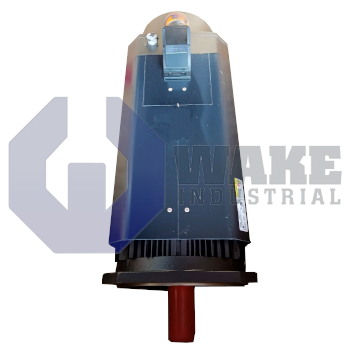
MAD160C-0200-SA-S2-FK0-05-N1 Bosch Rexroth Indramat
Wake Industrial LLC is not an authorized distributor of this product.
MPN: R911319410
No Tariffs On US Orders- Straightforward Pricing: No Rush Fees, No Credit Card Fees
The MAD160C-0200-SA-S2-FK0-05-N1 Spindle Motor by Bosch Rexroth Indramat delivers 44.0 kW rated power and 210 Nm torque, offering precision, efficiency, and durability. Its 2-pole design, cooling fan, and absolute encoder ensure reliable performance in demanding industrial applications.


To contact sales for pricing and lead time:
Payment Methods


Shipping Methods


Our Credentials


Product Description:
The MAD160C-0200-SA-S2-FK0-05-N1 motor is a high-performance motor from the MAD IndraDyn A Motors series manufactured by Bosch. It is designed for usage in industrial environments because it is durable and also it offers distinctive features. This motor has been fine-tuned for both efficiency and accuracy.
The MAD160C-0200-SA-S2-FK0-05-N1 Spindle Motor is rated for 210 Nm of torque and rated power of 44.0 kW. This spindle motor can withstand 93.9 amps of rated current and 2,000 min-1 rated speed. The MAD160C motor can operate at a maximum speed of 6,000 min-1 and also offers significant versatility. The motor’s cooling system includes an axial-flow fan that keeps the temperature normal. A single-turn absolute encoder with 2048 increments is also included for precise input. It can be utilized in a range of applications because it has a standard bearing and a flange mounting style. The MAD160C motor has a maximum torque of 494.2 Nm and a maximum power of 90.2 kW which indicates that it operates quite effectively when loaded. While at rest it produces a constant power of 225.0 Nm and a steady current of 93.9 A. The thermal time constant is 15 minutes which indicates that the motor will operate dependably for extended periods of time.
The MAD160C-0200-SA-S2-FK0-05-N1 Spindle Motor is designed to deliver consistent power and torque for difficult operations. Its robust 2-pole design ensures that it operates consistently at all speeds. The motor's moment of inertia is 0.311 kgm² allows smooth rotation. The power line's cross-section of 25.0 mm² enables efficient power transmission because it can generate up to 90.2 kW of power and 182.4 A of current. The MAD160C-0200-SA-S2-FK0-05-N1 servo motor is available at Wake Industrial.
Frequently Asked Questions about MAD160C-0200-SA-S2-FK0-05-N1:
Q: How does the 2-pole design in the MAD160C-0200-SA-S2-FK0-05-N1 Spindle Motor contribute to torque consistency across various speeds?
A: The 2-pole design reduces mechanical losses and enhances efficiency, ensuring steady torque output even at higher rotational speeds. This optimizes the motor’s performance in precision-demanding applications.
Q: How does the axial blowing fan in the MAD160C-0200-SA-S2-FK0-05-N1 Spindle Motor maintain thermal stability under high-load conditions?
A: The axial blowing fan increases airflow within the motor, preventing thermal saturation and ensuring heat is efficiently dissipated. This extends motor life and maintains consistent operational performance, even during continuous operation.
Q: How does the Single Turn Absolute Encoder with 2048 increments in the MAD160C-0200-SA-S2-FK0-05-N1 improve motion feedback precision?
A: The encoder provides precise position feedback with minimal error, enabling highly accurate control of speed and torque. This enhances closed-loop control in applications requiring high precision and minimizes positional drift.
Q: Why is the thermal time constant of 15 minutes critical for the MAD160C-0200-SA-S2-FK0-05-N1 Spindle Motor in high-performance tasks?
A: The thermal time constant of 15 minutes ensures the motor has enough time to dissipate excess heat, preventing thermal overload during high-power tasks. This feature ensures optimal performance in demanding industrial environments, avoiding overheating risks.
Q: How does the 2-pole design in the MAD160C-0200-SA-S2-FK0-05-N1 Spindle Motor contribute to torque consistency across various speeds?
A: The 2-pole design reduces mechanical losses and enhances efficiency, ensuring steady torque output even at higher rotational speeds. This optimizes the motor’s performance in precision-demanding applications.









