

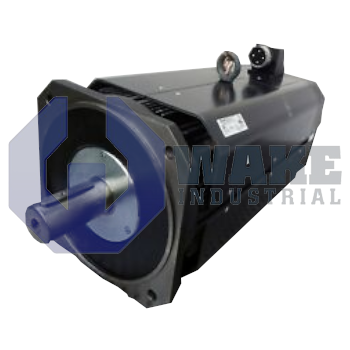
MAD160C-0150-SA-M2-BP0-35-R1 Bosch Rexroth Indramat
Wake Industrial LLC is not an authorized distributor of this product.
MPN: R911318884
No Tariffs On US Orders- Straightforward Pricing: No Rush Fees, No Credit Card Fees
MAD160C-0150-SA-M2-BP0-35-R1 Spindle Motor manufactured by Bosch Rexroth Indramat. This motor has a cooling mode with an Axail Fan, Blowing and a Singleturn Absolute, 2048 increments encoder. It also has a mounting style of Flange and a Standard bearing.


To contact sales for pricing and lead time:
Payment Methods


Shipping Methods


Our Credentials


Product Description:
The MAD160C-0150-SA-M2-BP0-35-R1 from Rexroth comes with a rotation torque of 215 Nm that it can generate when spinning at the speed of 1500 rotations per minute. This AC servo motor is designed for various industrial applications including manufacturing, molding, machine tools, industrial robotics, and CNC machines. This motor comes with all the features needed to control this servo motor as accurately as possible including a serial encoder and a tacho feedback system to help ensure the accuracy of the output of the servo motor.
This AC servo motor can draw varying levels of current depending on the mode it is operating at, for example, at the nominal or the normal duty mode, this AC servo motor can operate at the current rating of 75.3 amperes, while at heavy-duty locked rotor configuration the current requirement may increase to 77.8 amperes. The power draw of this motor is 33.8 kW while the voltage required to operate this AC motor is 460 volts AC with a 3-phase configuration needed to power each pole pair of this servo motor as MAD160C-0150-SA-M2-BP0-35-R1 comes with 3 pole pairs to rotate its shaft using electromagnetic induction.
The serial encoder on this servo motor requires 7 to 12 volts DC to operate and is a multiturn absolute encoder that can track the shaft rotations up to 4096 rotations per minute and also has a resolution of 2048 steps for one single rotation. Whenever the encoder detects a step, it generates a square wave pulse feedback signal which is then used by the motor control module to calculate the position of the shaft of the servo motor to help position the shaft accurately with the help of a closed loop feedback system.









