

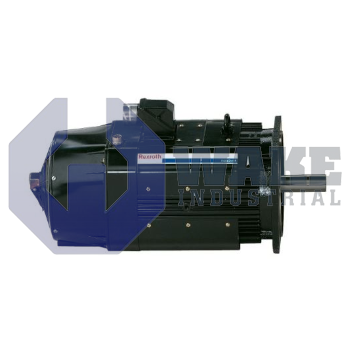
MAD100D-0250-SA-S2-AG0-05-N1 Bosch Rexroth Indramat
Wake Industrial LLC is not an authorized distributor of this product.
MPN: R911321476
No Tariffs On US Orders- Straightforward Pricing: No Rush Fees, No Credit Card Fees
MAD100D-0250-SA-S2-AG0-05-N1 Spindle Motor manufactured by Bosch Rexroth Indramat. This motor has a cooling mode with an Axail Fan, Blowing and a Singleturn Absolute, 2048 increments encoder. It also has a mounting style of Flange and a Standard bearing.


To contact sales for pricing and lead time:
Payment Methods


Shipping Methods


Our Credentials


Product Description:
The MAD100D-0250-SA-S2-AG0-05-N1 from Rexroth Indramat is a high-power servo motor that comes with a centering diameter of 100 mm and a frame size D. This servo motor has a power rating of 13.1 kW that requires 170 to 480 volts AC to operate and can draw up to a rated current of 32.4 amperes. At locked rotor conditions, this servo motor has a torque rating of 54 Nm while it draws around 34.7 amperes of current.
The axial blower fan on this servo motor has a voltage rating of 400 to 480 volts AC drawing up to 1.7 amperes of current and providing an airflow rate of 1000 m3 per hour which ensures that this servo motor is cooled very quickly, allowing the motor to dissipate less power and provide more performance. Speaking of the motor coil, this servo motor comes with 3 poles wrapped with coil winding having a winding resistance of 0.37 ohms that ensures a smooth flow of current, providing higher power output. It also has a winding inductance of 1.2 mH that provides a smooth flow of power to the motor coil without fluctuations in the supply by suppressing spikes in the input voltage to the coil.
With a single-turn encoder, this servo motor can rotate with higher accuracy as it has a resolution of 2048 increments per rotation. The encoder can only allow the motor shaft to rotate once. This encoder requires 5 volts DC to function with a nominal current draw of 28 mA. The encoder generates 5-volt pulses for feedback signals whenever an increment is detected. The feedback pulses will allow the motor controller to calculate the position of the motor shaft by counting the number of steps detected.









