


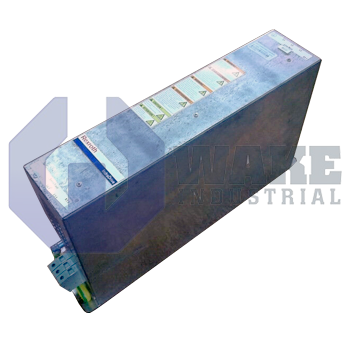
HMF01.1N-N0K1-M0215-N-690-NNNN Bosch Rexroth Indramat
Wake Industrial LLC is not an authorized distributor of this product.
MPN: R911329265
No Tariffs On US Orders- Straightforward Pricing: No Rush Fees, No Credit Card Fees
The Bosch Rexroth Indramat HMF01.1N-N0K1-M0215-N-690-NNNN is part of the HMF Motor Filters series and is designed for use with long motor cables. This filter is mounted at the motor output and supports parallel motors while limiting peak voltage to a maximum of 1000 V. It reduces interference voltages, leakage current, and output voltage rise to below 1 kV per microsecond.


To contact sales for pricing and lead time:
Payment Methods


Shipping Methods


Our Credentials


Product Description:
The HMF01.1N-N0K1-M0215-N-690-NNNN is a motor filter produced by Bosch Rexroth Indramat for the HMF Motor Filters series. Installed between an IndraDrive inverter and its connected motor, the unit conditions the high-frequency switching edges generated by pulse-width modulation. In industrial automation lines, this filtering limits electromagnetic emissions, controls voltage reflections, and reduces bearing currents so that long cable runs and adjacent control electronics remain within allowable stress margins while the drive retains the fast switching needed for precise positioning.
To serve applications that place the inverter far from the actuator, the filter is rated for long motor cables, and its network damps reflected waves that could damage insulation. Electromagnetic compatibility is improved because common-mode potentials are held to reduced interference voltages, and the frame-referenced level remains at a reduced interference voltage, which further lessens circulating currents. By shaping the return path, the design also yields reduced leakage current, which supports safety devices that monitor ground-fault levels. Mechanical installation is direct because the module bolts to the drive's motor output terminals, and its impedance profile also permits parallel motor operation from the same converter channel without additional tuning.
Switching transients are controlled so that the motor terminals see a reduced output voltage rise, which moderates dv/dt stress on winding insulation. Absolute amplitude is restricted to 1000 V maximum, guarding against overvoltage during regenerative events. The slope of each pulse is limited to below 1 kV/µs, a value that minimizes partial-discharge activity over extended cable trays and helps prevent interference with nearby sensor leads.