


CSB02.5B-ET-EC-NN-NN-NN-NN-NW Bosch Rexroth Indramat
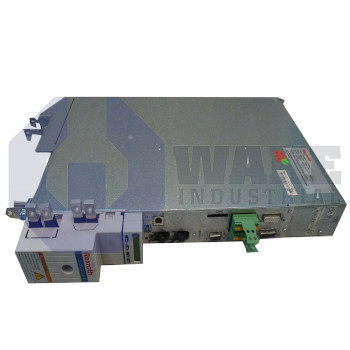
Wake Industrial LLC is not an authorized distributor of this product.
MPN: R911371230
No Tariffs On US Orders- Straightforward Pricing: No Rush Fees, No Credit Card Fees
The CSB02.5B-ET-EC-NN-NN-NN-NN-NW is a drive controller manufactured by Bosch Rexroth Indramat and part of the CSB Drive Controllers series. It provides 16 digital inputs, 5 digital outputs, and supports 3 analog inputs and 2 analog outputs. The controller features Multi-Ethernet communication, a multi-encoder interface, and supports fieldbuses such as sercos III, EtherCAT, EtherNet/IP, and PROFINET IO.


To contact sales for pricing and lead time:
Payment Methods


Shipping Methods


Our Credentials


Product Description:
The CSB02.5B-ET-EC-NN-NN-NN-NN-NW is produced by Bosch Rexroth Indramat for the CSB Drive Controllers series. It functions as a compact control section that ties power-stage hardware to higher-level automation networks, coordinating servo axes through real-time fieldbus traffic and local I/O processing. Within an industrial cell, the unit regulates motion modules, executes safety-related interlocks, and returns status data to supervisory PLCs. Its role also covers command exchange, feedback handling, and state monitoring across connected axes. This compact format suits control cabinets where axis coordination and network integration are managed in one module.
Electrical consumption is modest because the controller draws its logic supply from a single DC 24 V source. Start-up demand remains low because the inrush current stays below 5 A and lasts only 1 ms, so cabinet fusing can remain small. Continuous internal dissipation is limited to 17 W, and the optional ET interface adds just 1.1 W. A separate EC option increases load by another 1.0 W without requiring extra cooling. Relay contacts on the board can switch up to 1000 mA at 30 V, allowing direct actuation of pilot valves or signal lamps. Multi-Ethernet connectivity supports Sercos III, EtherCAT, EtherNet/IP, and PROFINET IO links, and a multi-encoder front end accepts MSM, MSK, MS2N, Hiperface, EnDat, TTL, SSI, or resolver feedback so different motor families can use the same controller frame.
The control card carries 3 analog inputs for speed or torque references, 2 analog outputs for diagnostic variables, 16 digital inputs for fast edge triggering, and 5 digital outputs for external interlocks or ready signals. The available I/O supports reference handling, diagnostic reporting, permissives, and machine-side status exchange. Multi-Ethernet routing lets the same hardware move between network standards without rewiring, and the multi-encoder interface supports machine zones that use different motor feedback formats. The relay functions and signal channels fit applications that need centralized control with a compact wiring footprint.