


BTM03.1-TA-TA-TA-TA-VA-NA-2EE-FW Bosch Rexroth Indramat
Wake Industrial LLC is not an authorized distributor of this product.
- Straightforward Pricing: No Rush Fees, No Credit Card Fees
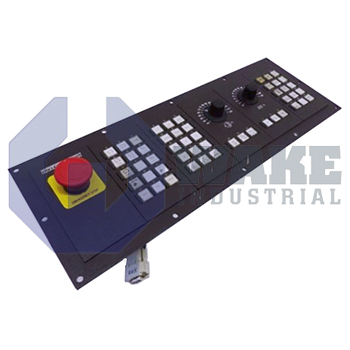
The Bosch Rexroth Indramat BTM03.1-TA-TA-TA-TA-VA-NA-2EE-FW is a panel from the BTM03 Machine Operator Panels series. It offers 6 emergency stop slots, 3 feed override pushbuttons, and 3 LEDs for feed override indicators. Each keypad slot supports 15 pushbuttons and 15 associated LEDs.


To contact sales for pricing and lead time:
Payment Methods


Shipping Methods


Our Credentials


Product Description:
The BTM03.1-TA-TA-TA-TA-VA-NA-2EE-FW is a membrane-key machine operator panel produced within the BTM03 Machine Operator Panels series. Designed for CNC and motion-control stations, the panel provides grouped pushbuttons, status LEDs, and an emergency-stop location that interface directly with the controller rack. Its role in industrial automation is to provide hard-wired, tactile command inputs and visual feedback for feed, spindle, and auxiliary functions, reducing dependence on screen navigation during repetitive production cycles. Because these commands are available on dedicated keys, common actions remain directly accessible during jogging, cycle interruption, and routine machine operation.
The emergency-stop circuit is routed to slot 6, reserving a dedicated position for the mushroom switch and keeping it separate from logic-level keys. Feed override is handled by 3 pushbuttons that let the operator increase, decrease, or reset the override value, and each key is paired with 3 LEDs that show the active percentage step. All feed-override wiring terminates at slot 5, which helps keep cable routing organized inside the cabinet. The unit is revision 1, indicating the first board layout for the keypad and LED matrix.
The keypad section occupies slots 1, 2, 3, and 4, giving four identical regions that can be mapped to axis selection, program start, or custom PLC functions. Each region provides 15 pushbuttons, and every switch is backed by 15 LEDs that illuminate through the overlay to indicate the current machine mode or fault status. This arrangement keeps the visual indication close to the related key, so status changes can be read quickly from the panel surface. Integration with compatible control systems is direct because pin assignments match the standard I/O ribbon used throughout the series.









